This account is from The Linzee Family, by John W. Linzee. It is particularly good in laying out the placement and respective roles of the British naval vessels involved.
The best few lines describe an exchange between General Gage and his subordinate, Willard:
Gage:“Who is in command of the Americans,” [and] “will he fight?”
Willard: “Yes, sir… he is an old soldier and will fight as long as a drop of blood remains in his veins.”
Gage: “The works must be carried.”
___________________
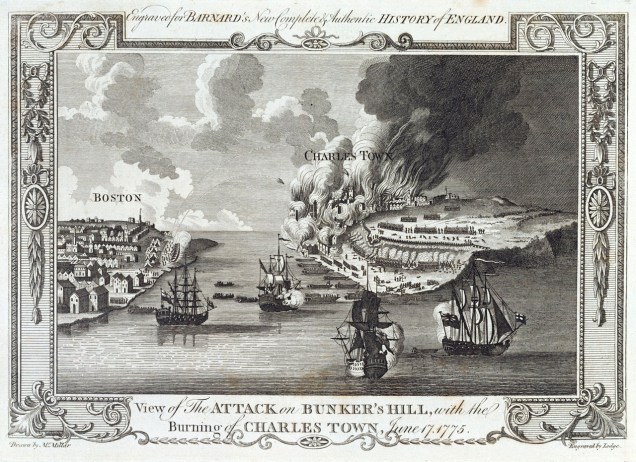
THE BATTLE OF BUNKER HILL
On the outbreak of the revolutionary conflict, Colonel William Prescott, a farmer of Pepperell, Mass., and a veteran of the Louisburgh expedition of 1746, also later with Winslow in the conquest of Nova Scotia, and known as a leader of dash and daring, attended on the 16th of June 1775 the secret call to arms on Cambridge common.
Already the Committee of Safety, in answer to their appeal, had collected from the New England towns about fifteen thousand men. Two regiments from New Hampshire were commanded by Colonel Stark and James Reed; three Rhode Island regiments under Colonels Varnum, Hitchcock and Church were on hand with General Green at their head; and three Connecticut regiments were led by Generals Israel Putnam, Joseph Spencer and Colonel Samuel H. Parsons. General Artemas Ward, the commander in chief of Massachusetts, was generally, though not officially, recognized as leader of the combined military forces.
The recommendation of the Committee of Safety to occupy Bunker Hill, was approved on the 16th of June. No time could be lost, as Generals Howe, Burgoyne and Clinton had reached Boston with reinforcements from England, and General Gage had determined to occupy Bunker Hill in Charlestown, which controlled Boston on the north, and Dorchester Heights which commanded Boston on the south, on or about the 18th of June.
A band of raw recruits, consisting of Prescott’s, Fry’s and Bridge’s regiments, about two hundred Connecticut troopers under Capt. Thomas Knowlton, and Capt. Samuel Gridley’s artillery company, were ordered by General Ward to proceed about nine at night, under the leadership of Colonel William Prescott, and to entrench themselves on Bunker’s Hill. The night was clear, a prayer for their safety by the Rev. Dr. Langdon, president of Harvard College, started them on their eventful march. They arrived at their destination in two hours, poorly armed and inadequately provisioned; the total force was a trifle over twelve hundred men, augmented when crossing Charlestown Neck by a few hundred reinforcements and General Putnam and Major Brooks.
 Kinsmen and Kinswomen