The Death and Burial of Gertrude Lawrence Peabody (1855-83), as Recorded by Fannie Peabody

In May of 1883, after having been ill for only a few days, Gertrude Lawrence Peabody, just 28 years old and the mother of two small children, died.

For more on the memory hole her absence left in our family, see this post here.

Recently, a kind and thorough researcher at Groton School, Alyssa Mattei, in the course of preparing for an article in The Groton Quarterly on Lawrence women’s contributions to that institution, happened upon my blog post and became intrigued. Picking up where I had been forced to leave off, she decided to go looking in the journals of the wife of the school’s founder, Fannie Peabody, which are preserved in Groton’s archives, for the entries on the days surrounding Gertrude’s death to see what she could find. It was a shot in the dark, but one worth taking. Long story short, Alyssa made a really wonderful discovery.

Over three successive days, Fannie meticulously documented the news of Gertrude’s death, accounts of her last hours, her husband’s and family’s effort to bear her loss together, and the funeral at Harmony Grove.

The only issue, once Alyssa had found the pages, was reliably reading the archaic script, and figuring out who was who. For that, she then passed the baton back to me, and I got to work. The rest of this post is my attempt to first read, and then document, what happened.

Why does this matter? Because as I wrote, years ago now in the post on Gertrude’s legacy, there is, or was, SO little known about her, especially including her death. These entries offer a deeply intimate look at Gertrude’s emotional composure while dying, some of her last words, the immediate reactions of family and friends, the comings and goings as people sought community and solace with one another and prepared for her service, the male relatives carrying her coffin, the actual hymns that were sung, the flowers placed in the grave, and the lasting grief as shock gave way to resignation…

It’s as though we can now be there, and in some small way, count ourselves among the witnesses to her life.

Continue reading
Links to Collaborative Genealogy Sites

In the interest of seeing that our family tree, the actual genealogical “who, when, and where” is preserved, I have placed some of the research that went into this blog on five websites, four of which actually aim to piece together, person by person, a single family tree for everyone. Taken literally, that is wildly ambitious, not to mention completely impractical, but the effort alone has already produced, flaws and shortcomings notwithstanding, a very special body of research.

These “collaborative” genealogy sites are Geni, WikiTree, WeRelate, and FamilySearch. Each is a little different.

For example, Geni and WikiTree make room for all relatives including living people and then add privacy controls. WeRelate, meanwhile, has decided to forego information on living people and just focus on the near past. Geni makes little use of sources or documentation, but WikiTree and especially WeRelate strive, with varying success, to back up all assertions with primary documents. There are plenty of other differences, but that’s the gist of it.

The main point is that putting the information here means it will survive even in generations when no one inherits an interest in family history– something I see as increasingly  likely.

Here are some jumping off points, categorized first by site, and then by a few key relatives…


Geni:


WikiTree:


WeRelate:


FamilySearch:


Finally, I said there are five sites. The fifth is Ancestry.com, which somewhat sadly, has a paywall and curious people cannot simply click over to peruse the material at will. You can see it without a financial outlay, but to do so you’ll have to email me or Elisha Lee to be put on a list of invitees. Sorry, I didn’t make up those rules. If you are already on Ancestry, you can search for our tree which is called Kinsmen and Kinswomen (revised and sourced). [18,000 relatives and counting.] On the plus side, looking for a silver lining, the highly commercial aspect of Ancestry has paid huge dividends in making a vast trove of documents available online, including – in most cases – photocopies of originals. This includes birth certificates, marriage entries in the parish register, passport applications, draft registrations, VA records, medical examiners’ notes, high school yearbooks, biographical vignettes, and on and on. People can also share multiple digital copies of rare family photos.  There really is nothing like it for primary research.

At some point in the distant future, I’ll figure out how to put a version of our tree here, on this site, with measures in place to protect people’s privacy, but until then, the organizations above will have to suffice.

Sports Teams at Groton School, c. 1894-6

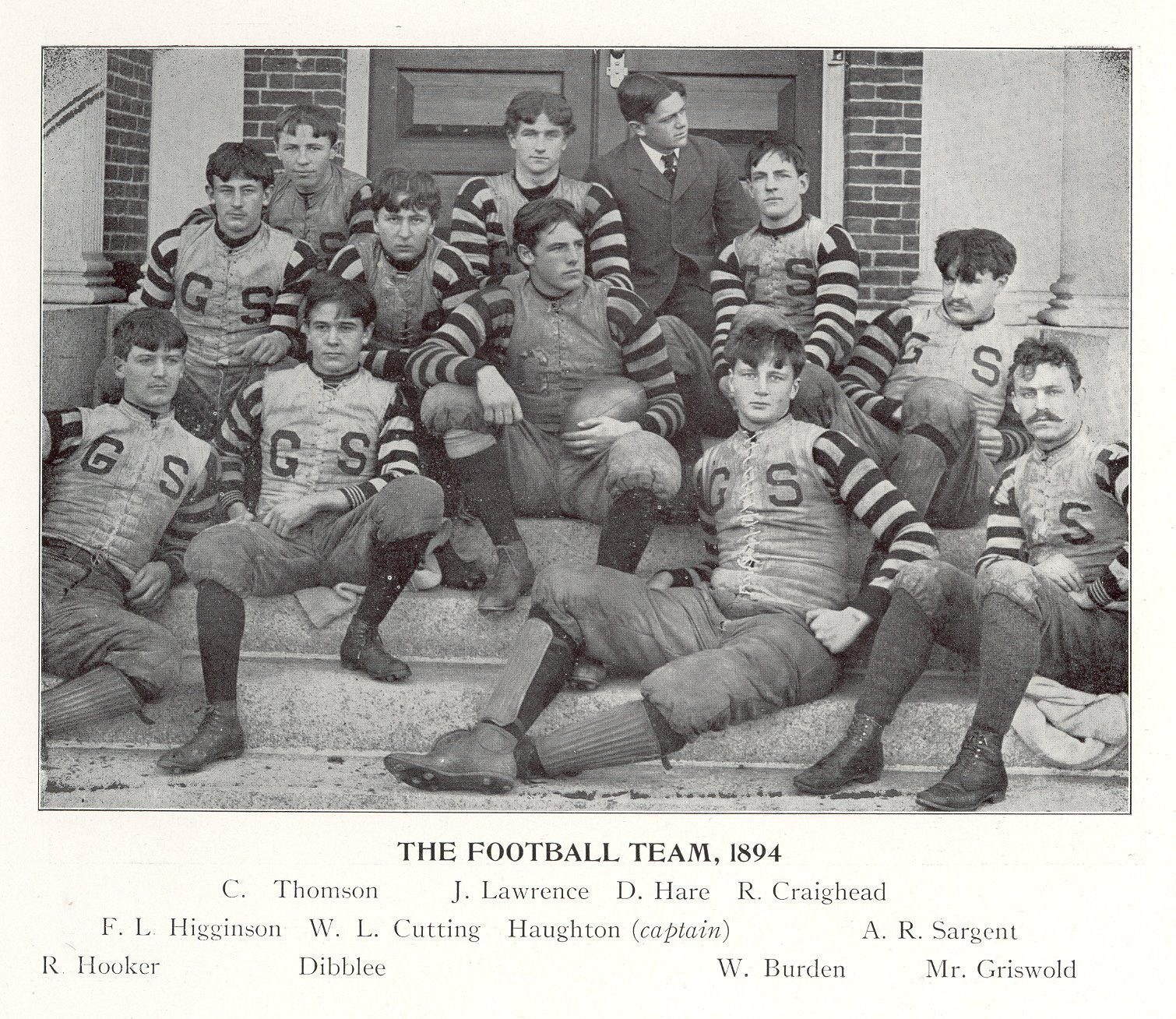
I came across these on eBay a couple of years ago, and snapped them up for literally a few dollars. I bought them because they show my great-grandfather, James Lawrence (1878-1969) and his friends and classmates at Groton, as they appeared in their youth.

Looking at them, I can’t help but be reminded of the wonderful scene in Dead Poets Society in which the main character, John Keating, played by Robin Williams, offers to his students the following timeless advice:

They’re not that different from you, are they? Same haircuts. Full of hormones, just like you. Invincible, just like you feel. The world is their oyster. They believe they’re destined for great things, just like many of you. Their eyes are full of hope, just like you. Did they wait until it was too late to make from their lives even one iota of what they were capable? Because you see, gentlemen, these boys are now fertilizing daffodils. But if you listen real close, you can hear them whisper their legacy to you. Go on, lean in. Listen. You hear it?… Carpe… Hear it?… Carpe. Carpe diem. Seize the day, boys. Make your lives extraordinary.

___________

Groton School yearbook photos 1894-1896 00004

Groton School football team, 1894

Thomson, Lawrence, Hare, Craighead, Higginson, Cutting, Haughton, Sargent, Hooker, Diblee, Burden, Griswold

Continue reading

Capt. Joseph Lee and The Boston Tea Party

So far, in telling the story of our family’s involvement in the Revolutionary War, we’ve had ancestors who were founding members of the Sons of Liberty; who were Minute Men; marched to Lexington and Concord; officers who fought (on both sides) at Bunker Hill; were part of the Quebec campaign; were taken prisoner; wintered at Valley Forge; and were present at the surrender of Burgoyne.

Recently, I remarked in an email to my cousin, Elisha Lee, Jr., that – despite all this – to my knowledge, no one in our family had gone out that famous night, to The Boston Tea Party. One of the signal events of the Revolution in New England. It  is true that not everyone who was there admitted it, for fear of the repercussions, but still. Just something interesting to note.

After about twelve hours of radio silence, but no more, Elisha got back to me with one name: Capt. Joseph Lee, an ancestor we both share. He was there, and helped to dump the tea in the harbor.

I consulted several lists of known participants. (Here is one; here is another.)  Lee was mentioned on all of them. There appears to be no controversy.


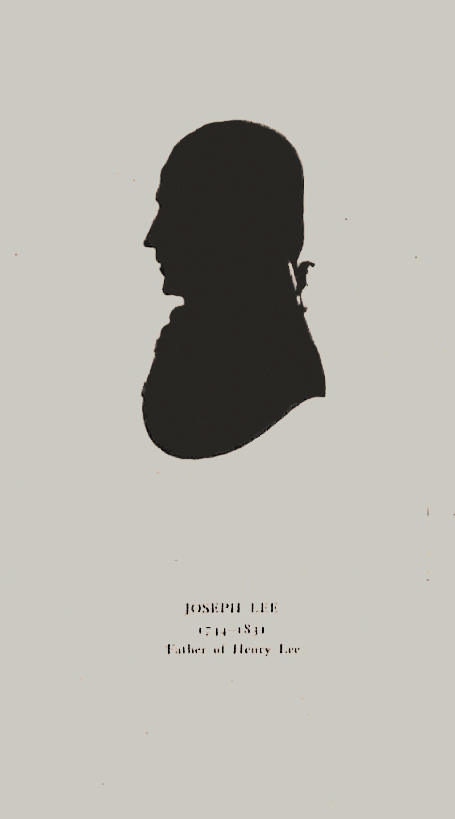
Capt. Jos. Lee 1744-1831 alt2

Source: Morse, Frances Rollins (1850-1928).

Henry and Mary Lee, letters and journals : with other family letters, 1802-1860, p.14
URL: https://archive.org/details/henrymaryleelett00mors/page/14/mode/2up


So who was he? As a youngish man, Joseph Lee was a merchant on Long Wharf. He had a fleet of privateer ships during the Revolution, which he seems to have used both to aid his country and enrich himself. In addition, he was a shipbuilder, an engineer of public works, a distiller, a gardener, and a philanthropist. He had two wives and numerous children. While not a lot has been written about the man, in the sense of memoir or lengthy biographies, it appears he lived a full life indeed.

Here are a few available items to guide further research.


Continue reading