When Thomas Burgin and his wife Jane (Skudder) Burgin emigrated to America, they left behind at least two generations of history in the London neighborhood of, generally, Bermondsey, which sits in the Borough of Southwark, and more specifically, the church parish of St. John Horselydown.
For years I have dreamed of going back there, to retrace their steps and imagine as best I could a bit of their experience, but sadly little of the area as they knew it has survived. An absolutely massive fire in 1861 (more on this later), Victorian “progress,” the Blitz, and post-WWII reconstruction, have largely obliterated the streets and shops and the residences of their world. A visit today would reveal mostly modernist architecture, lots of steel and glass, and only a few of even the original place names. (I should perhaps mention that London’s world-famous Tower Bridge stands close by, quite hard to miss, but somewhat ironically had not yet been built when our ancestors lived here.)
With those caveats in place, I have been able to find their old neighborhood in a famous period map as well as on Google Maps, and compose a side-by-side comparison, a geographic “then vs. now,” for anyone who is curious.
Let’s start with the maps.
The top map here is a close-up detail of the Greenwood map of 1827, whole map available here, detail below available here. There is a less well photographed, but undivided/unsegmented, version here. The bottom map is a simple screen capture from Google Maps, taken in October of 2026. I have tried to scale them as identically as possible. If you continue on, I describe each of the locations tagged with a red dot.
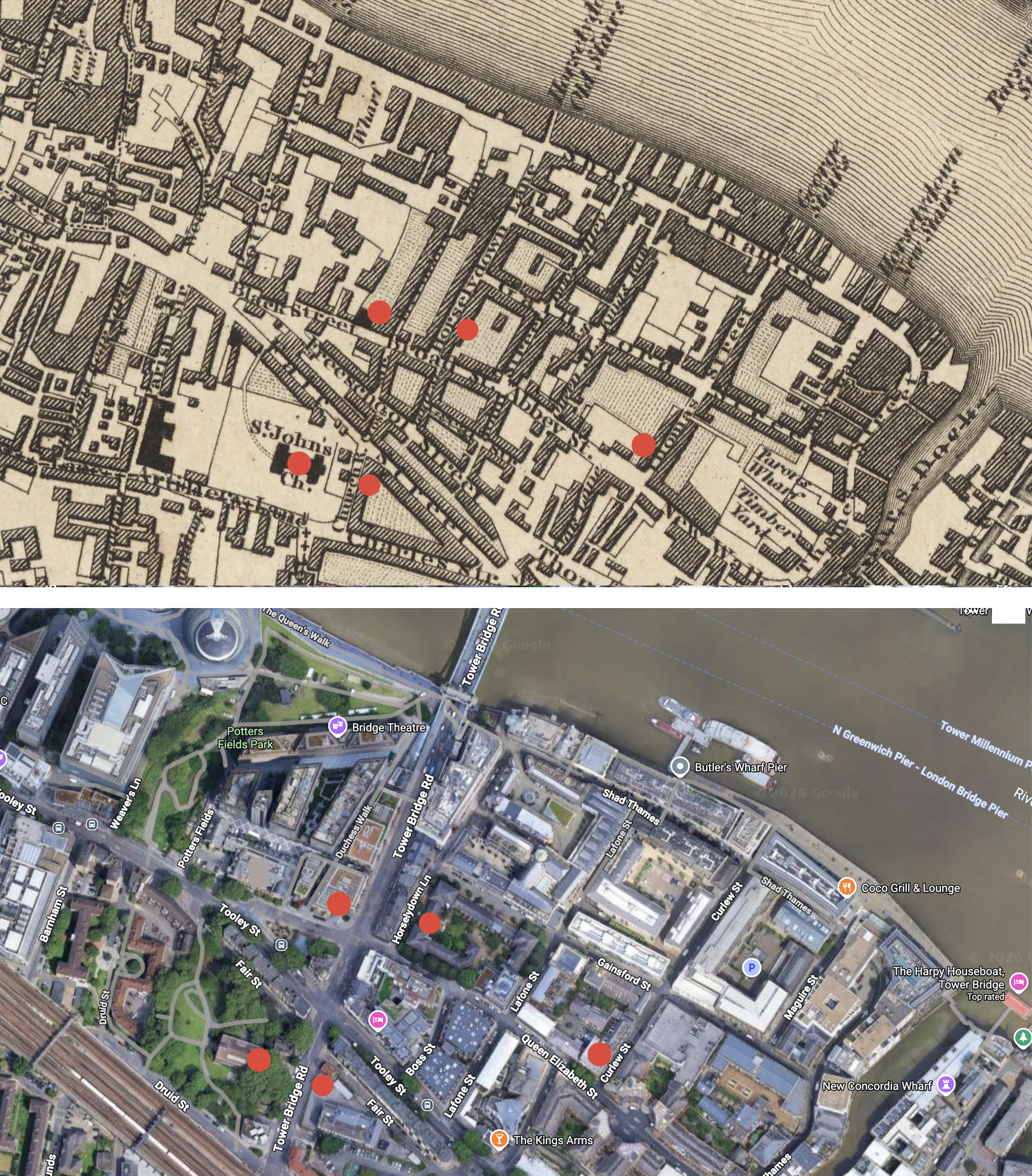
Here below is a concise guide to just a few of the historical sites, specifically mapped to modern London landmarks for a traveler on foot.
1. The focus of our family’s civic and religious life: The Anglican parish church, St. John Horselydown
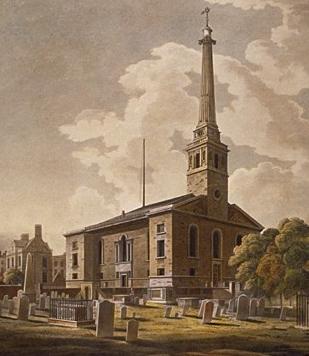
Source: Wikipedia.
- Origins (1727–1733): The church was commissioned under the 1711 Act for Building Fifty New Churches to serve the explosive growth of the Southwark dockworker population. It was co-designed by Nicholas Hawksmoor (the legendary Baroque architect) and John James.
- The Landmark Spire: The church was famous across South London for its architectural eccentricities. Its towering spire was uniquely carved into the shape of a tapering classical column and topped with an extraordinary iron weather vane depicting a soaring comet. Historian Nikolaus Pevsner affectionately called it a “silly but lovable spire.”
- Destruction in the Blitz: Because Horselydown was packed with heavily targeted shipping wharves and industrial factories, it was directly in the crosshairs of the German Luftwaffe. On the night of September 20, 1940, a direct hit from a high-explosive bomb utterly gutted the church.
- The Aftermath: The blast shattered the roof and the legendary comet spire. Only the battered stone north, west, and east outer walls were left standing. The shell was officially closed in 1968, and the parish was amalgamated into nearby St. Mary Magdalen.
- Traveler Directions: The site of the old church of St. John Horsleydown is located inside what is now called St John’s Churchyard Park in Bermondsey (London SE1 2AG).
2. The grocery shop of John Skudder (1820s-40s) at #22 Back Street
First a primary source describing the location of B(l)ack Street:
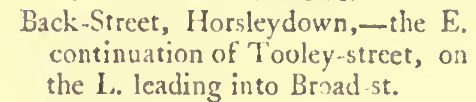
Source: Lockie’s Topography of London, available here.
An 1832 listing of the businesses on Back Street, as text:
Back street, Horselydown
Three Tuns, Sydenham W
8 Manley Robert
4 Westerman John
Ledger Edw & Son
10 Hannerford James
11 Barker John
Mallet Thomas
21 Black William
22 Scudder I
Three Compasses, Shorter John
An 1842 listing, showing some names had changed, as an image:
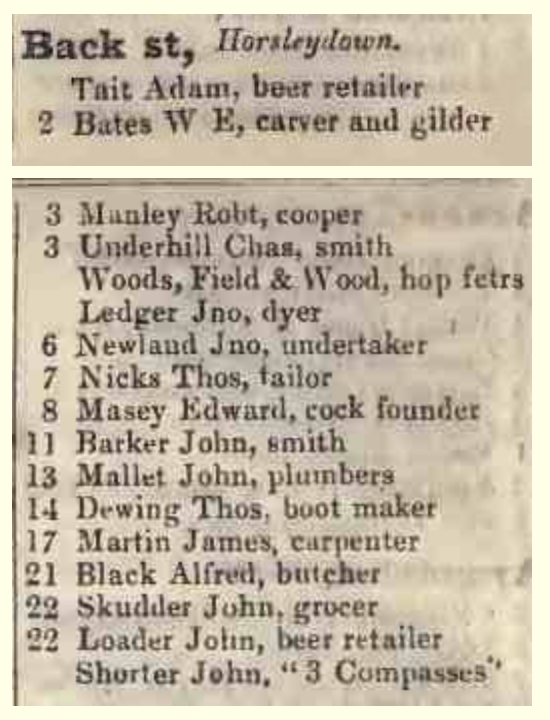
Source: London Robsons Street Directory in 1832/1842 – Back street, Horselydown, available here. See also here.
A brief historical note: the name on the map at the top of this post is Black Street, but the name on the baptismal and business records is Back Street. Early property deeds and the 1851 Census (HO 107/1559) explicitly record residents living at the western tip of the road as residing at “Gateway, Black Street,” while contemporary directories alternate the spelling to “Back Street,” proving they were physically the same road. By 1842, directories permanently standardized the spelling to Back Street to eliminate postal confusion, reflecting its position running directly behind (“back of”) the major Tooley Street riverfront wharves.
In addition to being listed as a grocery, this was the address give on all of the Skudder children’s (including Jane’s) births and baptisms as recorded in the bishop’s transcript. Clearly a place of business below, and a living quarters above.
- Historical Address: #22 Back Street (also recorded on early maps as Black Street), Horselydown.
- Modern Location: Queen Elizabeth Street, SE1. (Mentioned as #77 Queen Elizabeth Street in John’s probate document.)
- Traveler Directions: Walk to The LaLiT London hotel (181 Tooley St). The hotel’s grand Victorian dining hall sits directly on top of the old eastern stretch of Back Street. Number 22 sat right along this immediate property footprint. The Dixon hotel next door at 211 Tooley Street marks the western throat where Back Street street originally met Tooley Street.
3. John Skudder, Sr.’s home at the time of his death on Church Row
John didn’t end his days at #22 Back Street. At some point after the 1851 Census he moved to Church Row.
- Historical Address: Church Row, Horselydown.
- Modern Location: The eastern edge of the St. John’s Churchyard green.
- Traveler Directions: Walk into the park space of the former St. John’s Horselydown churchyard (just east of Tower Bridge Road). Church Row, also written as Church-row, ran directly along the eastern flank of this church property line, facing the burial grounds and connecting toward the Queen Elizabeth Street loop.
4. Thomas Burgin & Jane (Skudder) Burgin’s home prior to leaving for the U.S. [probably also the last home of John Burgin and his wife Jane (Boak) Burgin] at #4 Thomas Street
- Historical Address: #4 Thomas Street, Horselydown. (Thomas Street was re-named Curlew Street.)
- Modern Location: Near the intersection of Curlew Street and Queen Elizabeth Street, SE1.
- Traveler Directions: Walk down Curlew Street into the heart of the Shad Thames warehouse district. Number 4 sat near the northern commercial crossroads where Curlew Street meets Queen Elizabeth Street. This site is safely north of the modern London Bridge railway viaducts.
And finally, a bit of informed speculation…
5. One possible catalyst for their emigration(?): The Great Tooley Street Fire (1861)
This is truly worth Googling, or just start with the Wikipedia entry here. It was the largest conflagration since the Great London Fire, and it burned for two weeks. The first “level” of damage was the physical destruction to the dock area. The second “level” was the crippling downstream supply-chain impacts on the businesses of the entire surrounding area. Did this play a role in the Burgins’ decision to leave for America a little more than two years later? Impossible to say, but one can imagine a semi-prosperous upholsterer looking at a catastrophic interruption of business, with the futures of young children at stake, and saying, “Enough!”
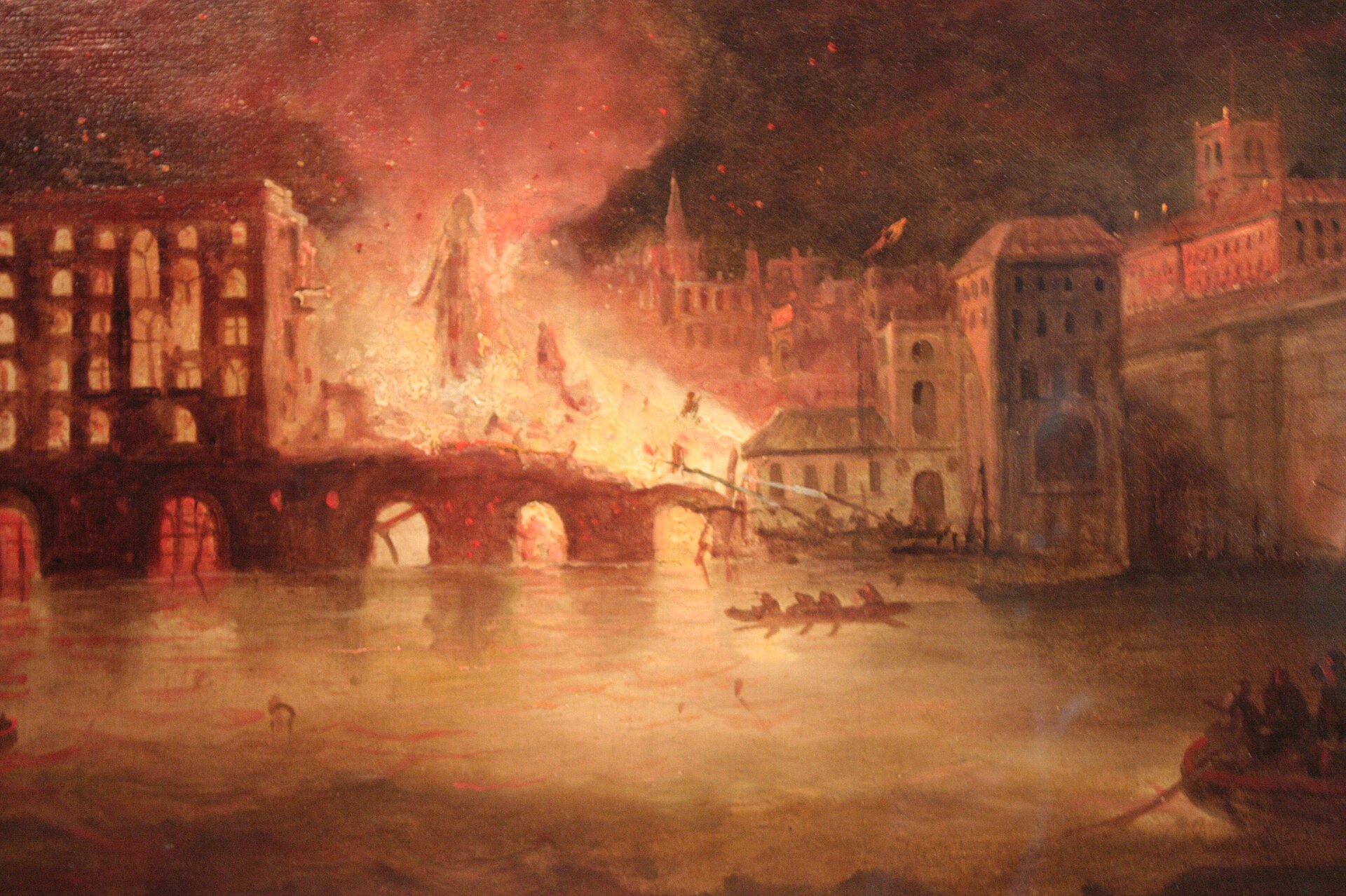
Image source Wikipedia, available here.
- Historical Event: A massive 11-acre riverfront inferno that broke out two months after the 1861 Census, triggering the economic depression that possibly prompted the family’s emigration to America.
- Modern Location: Hay’s Galleria (formerly Cotton’s Wharf) and Battle Bridge Lane, SE1.
- Traveler Directions: Stand at the riverfront by Hay’s Galleria. The fire raged directly here. The Burgins, in their home at #4 Thomas (now Curlew) Street, were living a mere 250 yards east of the destruction zone, well within the radius of the toxic smoke and flying embers.
Parting Questions
A childhood unlike that known by children today
Jane Skudder grew up above a grocery, but in a building shared with a beer retailer, and less than a block away from a well-known pub.
The neighborhood was surrounded by tanneries, vinegar yards, and starch factories that dumped toxic runoff straight into the local ditches and the Thames.
By the 1840s and 1850s, London’s parish churchyards were notoriously, catastrophically overcrowded. St. John’s Horselydown was a tightly packed urban graveyard handling thousands of cholera and typhoid victims from the dense local slums. The soil was literally putrefying. The graves at the West Norwood Cemetery in Lambeth were routinely turned over. The Skudders’ listings there are purely administrative. (On FindaGrave, John is here and Mary is here.) They do not map to two specific plots, as the decedents’ bones were routinely moved and mixed.
What was all that like? How did it shape who Jane was, and her sense of agency? Did she convey any of this to her children, including to young Clarence Burgin, my great-grandfather, the first child in her family to be born in America?
A global scattering
Long before the 1861 fire (possibly) pushed Jane (Skudder) Burgin to America, the family was already fragmenting. John Jr. left for Australia in 1852 at just 17 years old. By 1864, Jane and her husband Thomas were crossing the Atlantic to Vermont and then Massachusetts. After the parents’, Mary’s and John’s, deaths in 1864 and 1866 respectively, Mary Ann (Skudder) Spencer left for Vermont in 1868. Only Emma (Skudder) Kilby, and sister Eliza Scudder were left. All told, 3 out of the 5 surviving adult children, not to mention the children’s children, participated in this generational exodus from Southwark.
What did these siblings perceive about the long-term economic stagnation or health decline of Horselydown that made staying feel impossible?
Were there emotional reasons for leaving?
Jane’s mother, Mary (Russell) Skudder, died in February 1864. Within two months, Jane boarded the ship to America. Over and above the fallout of the terrible fire…Was her mother’s death the final anchor chain breaking? Or, knowing her daughter was leaving, did grief at the coming separation kill Mary? We will never know.
The melancholy of 6 Church Row
I imagine John Sr. spending his final two years at 6 Church Row. There must have been a great deal of loneliness embedded in that geography. By 1864, his wife was dead, his son was in Australia, and his daughter and four grandchildren were in America. Three daughters remained. (Of these, one more to leave, following her sister, in 1868.) The retired grocer moved out of his busy lifelong shop at (per the probate record) formerly #22 Back Street, now #77 Queen Elizabeth Street, and spent his final days looking out at the St. John’s churchyard, the site of so many of his family’s baptisms and weddings. He relied on a local neighbor to execute his final wishes and estate.
***
FURTHER READING (in no particular order)
BERMONDSEY.—TOOLEY STREET, &c. in BHO | British History Online: CHAPTER IX – A rambling history of the area and its old landmarks
The Tailor Of Horsleydown. October 5, 2018 – A very nice blog entry, much in the vein of this one.
The History of Potters Fields Park – A nice exploration of a remaining bit of open land just northwest of the area we’ve been looking at. Top left in the map I showed at the start.
Wikipedia entry on the parish of Southwark St John Horsleydown. – A few good facts and a readable map.
Wikipedia entry on the actual Anglican church St John Horsleydown. – Concise but helpful.
“The River Seemed Almost Turned to Blood”: The Tooley Street Fire by Nancy Rose Marshall – A really fine history, with phenomenal – unfortunately copyrighted – illustrations.
_____

