Returning to Old Southwark: The Neighborhood Thomas and Jane (Skudder) Burgin Left Behind

When Thomas Burgin and his wife Jane (Skudder) Burgin emigrated to America, they left behind at least two generations of history in the London neighborhood of, generally, Bermondsey, which sits in the Borough of Southwark, and more specifically, the church parish of St. John Horselydown.

For years I have dreamed of going back there, to retrace their steps and imagine as best I could a bit of their experience, but sadly little of the area as they knew it has survived. An absolutely massive fire in 1861 (more on this later), Victorian “progress,” the Blitz, and post-WWII reconstruction, have largely obliterated the streets and shops and the residences of their world. A visit today would reveal mostly modernist architecture, lots of steel and glass, and only a few of even the original place names. (I should perhaps mention that London’s world-famous Tower Bridge stands close by, quite hard to miss, but somewhat ironically had not yet been built when our ancestors lived here.)

With those caveats in place, I have been able to find their old neighborhood in a famous period map as well as on Google Maps, and compose a side-by-side comparison, a geographic “then vs. now,” for anyone who is curious.

Let’s start with the maps.

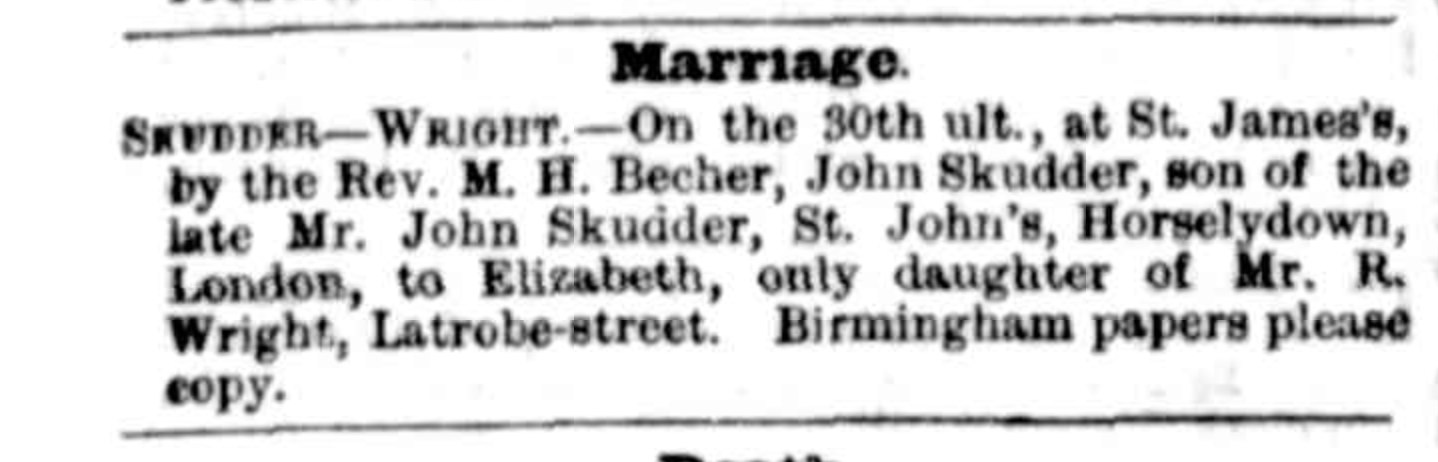
The top map here is a close-up detail of the Greenwood map of 1827, whole map available here, detail below available here. There is a less well photographed, but undivided/unsegmented, version here. The bottom map is a simple screen capture from Google Maps, taken in October of 2026. I have tried to scale them as identically as possible. If you continue on, I describe each of the locations tagged with a red dot.
A comparison of a historical map and a modern aerial view of the same area, highlighting specific locations with red markers.

Here below is a concise guide to just a few of the historical sites, specifically mapped to modern London landmarks for a traveler on foot.

Continue reading →

At Long Last: The Australian Descendants of John Skudder, Jr. (1835-1883)

In two previous posts, Searching for the Origins of John Skudder (c. 1796 – 17 Jul 1866) and Mary (Russell) Skudder (c. 1802 – Feb 1864), both of Southwark, Surrey, and also The Missing Ancestry of Thomas Burgin and Jane Skudder: What DO We Know?, I mentioned that John Skudder, Sr. and his wife Mary (Russell) Skudder had a son, John Skudder, Jr. who emigrated from England to Australia, and arrived there on the 25th of Nov 1852 at Port Phillip Bay in Melbourne. What happened to him after that has been, at least from the North American Skudders’ perspective, a mystery.

A little more than two years later, on the 10th of January, 1855, a newspaper ad appeared in The Argus, in which John Skudder, Sr. and his wife Mary, writing from London, requested that their apparently uncommunicative son, John, Jr., please get in touch. As parents everywhere across the ages will relate, they hadn’t heard from him and they were worried.

The Argus (Melbourne, Vic.) Wed 10 Jan 1855; Page 1 (right hand column, fourth entry down)

A vintage newspaper announcement addressed to John Scudder from Horsleydown, stating that his parents are anxious about him and encouraging him to communicate with R. Ridoutt in Prahran.

“JOHN SCUDDER (sic), of Horsleydown, your parents are anxious about you. Communicate with R. Ridoutt, Prahan. 173”

Did John ever see this or answer? Was he even alive to see it? Did we have relatives in Australia, or was he simply a young voyager who disappeared into history? For at least most of the 20th and the first quarter of the 21st century, no one in our family knew the answers to these questions. Until…

Roughly a month ago, perusing cemetery listings as one does, I stumbled upon a FindaGrave profile for an Australian man named John Skudder. In the moment, I thought this was not remarkable, as I assumed there would have been multiple men of that name. One more profile to cross off the list and move on. But, in the bio section I saw a block quote that made me catch my breath. There, as part of an announcement of a second marriage, was a description of the fortunate couple’s respective fathers:

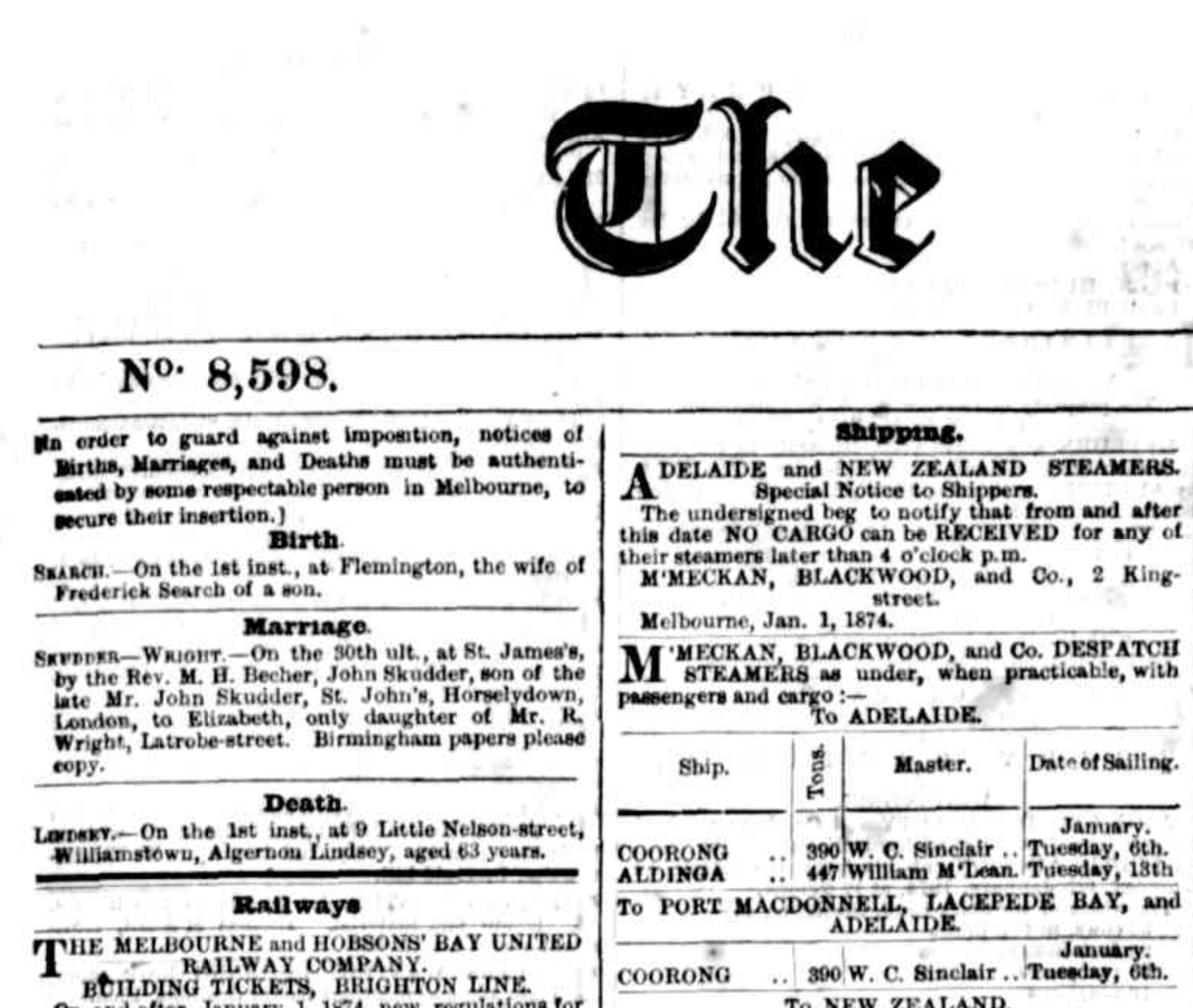
“Marriage Notice in The Argus of Jan 2, 1874: SKUDDER-WRIGHT. —On the 30th ult., at St. James’s, by the Rev. M. H. Becher, John Skudder, son of the late Mr. John Skudder, St. John’s, Horselydown, London, to Elizabeth, only daughter of Mr. R. Wright, Latrobe-street. Birmingham papers please copy.”

Thunderbolt! There it was in black and white, proof positive that THIS John Skudder, recently wed—evidently—to a woman named Elizabeth Edith Wright, whose parents hailed from Birmingham, England, was in fact OUR John Skudder who had more or less disappeared Down Under 174 years ago.

Wanting to prove it, though, to see for myself, I went to the Argus’ online archive. It was easy to find. Page 1 news, above the fold, top left.

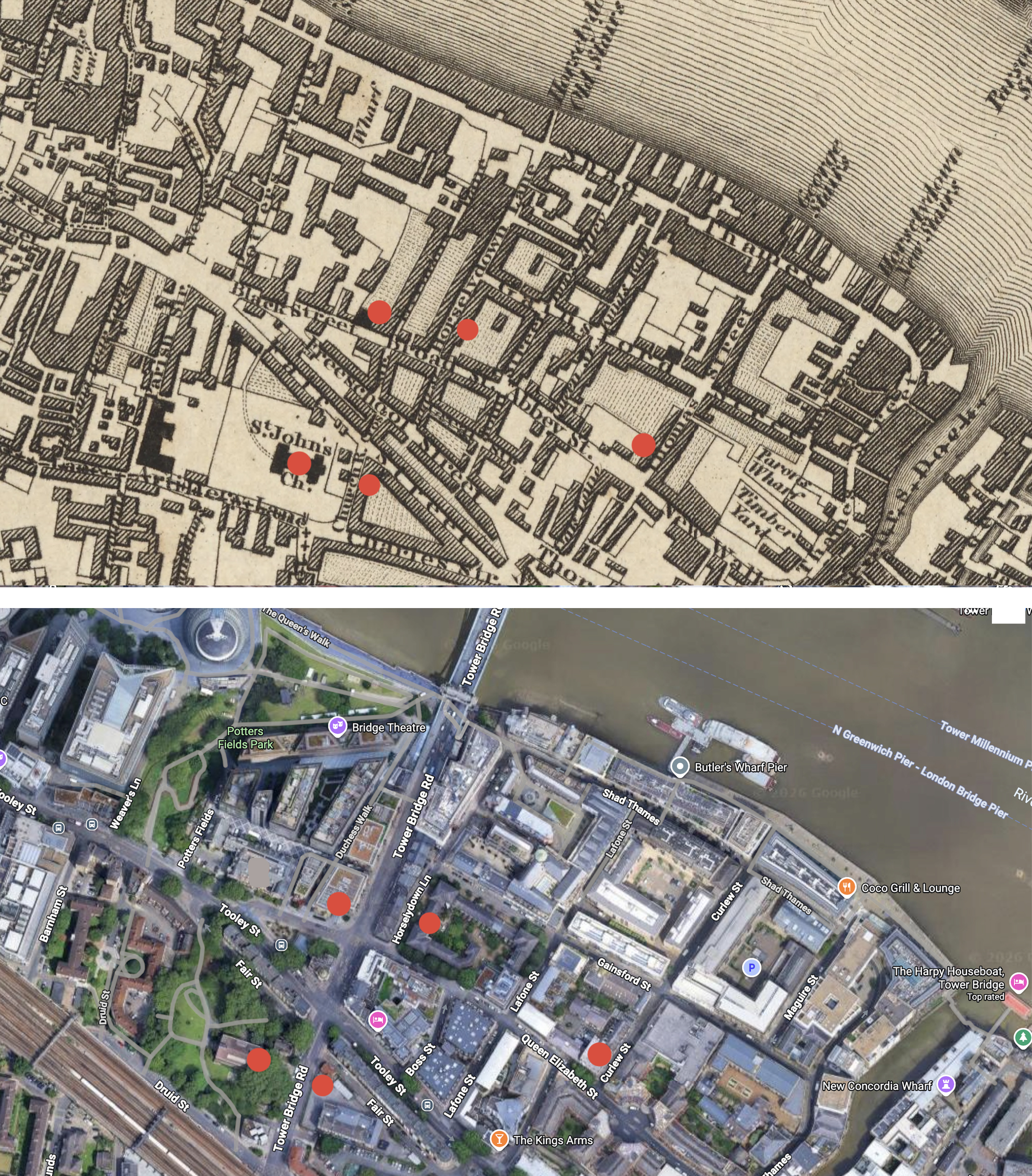
From The Argus (Melbourne, Vic.: 1848 – 1957) Fri 2 Jan 1874 Page 1

A newspaper clipping featuring birth, marriage, and death announcements, along with shipping notices and railway information from Melbourne, dated January 1, 1874.

Enlarging it…

Marriage announcement for John Skudder and Elizabeth Wright, detailing the ceremony at St. James's and the officiant.

There it was, just as quoted on FindaGrave. Finally!

Continue reading →

Searching for the Origins of John Skudder (c. 1796 – 17 Jul 1866) and Mary (Russell) Skudder (c. 1802 – Feb 1864), both of Southwark, Surrey

“The yarns of seamen have a direct simplicity, the whole meaning of which lies within the shell of a cracked nut. But Marlow was not typical (if his propensity to spin yarns be excepted), and to him the meaning of an episode was not inside like a kernel but outside, enveloping the tale which brought it out only as a glow brings out a haze, in the likeness of one of these misty halos that sometimes are made visible by the spectral illumination of moonshine.”

Joseph Conrad, Heart of Darkness

I’ve often thought about these lines. And I’ve mused how they might apply, or not apply, to family history research. We look and look and look for the missing kernel of truth, the fact – the particular birth, the marriage, the death, and its dates – upon which we can build and expand and elaborate all the others that follow. But sometimes there is no kernel of truth. No one fact. Just a list of competing, though in the end not terribly different, theories. And the truth, if we are ever to know it, will be found not in one theory or another, proven correct or incorrect, but in the vague haze that surrounds all of them.

Continue reading →