In two previous posts, Searching for the Origins of John Skudder (c. 1796 – 17 Jul 1866) and Mary (Russell) Skudder (c. 1802 – Feb 1864), both of Southwark, Surrey, and also The Missing Ancestry of Thomas Burgin and Jane Skudder: What DO We Know?, I mentioned that John Skudder, Sr. and his wife Mary (Russell) Skudder had a son, John Skudder, Jr. who emigrated from England to Australia, and arrived there on the 25th of Nov 1852 at Port Phillip Bay in Melbourne. What happened to him after that has been, at least from the North American Skudders’ perspective, a mystery.
A little more than two years later, on the 10th of January, 1855, a newspaper ad appeared in The Argus, in which John Skudder, Sr. and his wife Mary, writing from London, requested that their apparently uncommunicative son, John, Jr., please get in touch. As parents everywhere across the ages will relate, they hadn’t heard from him and they were worried.
The Argus (Melbourne, Vic.) Wed 10 Jan 1855; Page 1 (right hand column, fourth entry down)

“JOHN SCUDDER (sic), of Horsleydown, your parents are anxious about you. Communicate with R. Ridoutt, Prahan. 173”
Did John ever see this or answer? Was he even alive to see it? Did we have relatives in Australia, or was he simply a young voyager who disappeared into history? For at least most of the 20th and the first quarter of the 21st century, no one in our family knew the answers to these questions. Until…
Roughly a month ago, perusing cemetery listings as one does, I stumbled upon a FindaGrave profile for an Australian man named John Skudder. In the moment, I thought this was not remarkable, as I assumed there would have been multiple men of that name. One more profile to cross off the list and move on. But, in the bio section I saw a block quote that made me catch my breath. There, as part of an announcement of a second marriage, was a description of the fortunate couple’s respective fathers:
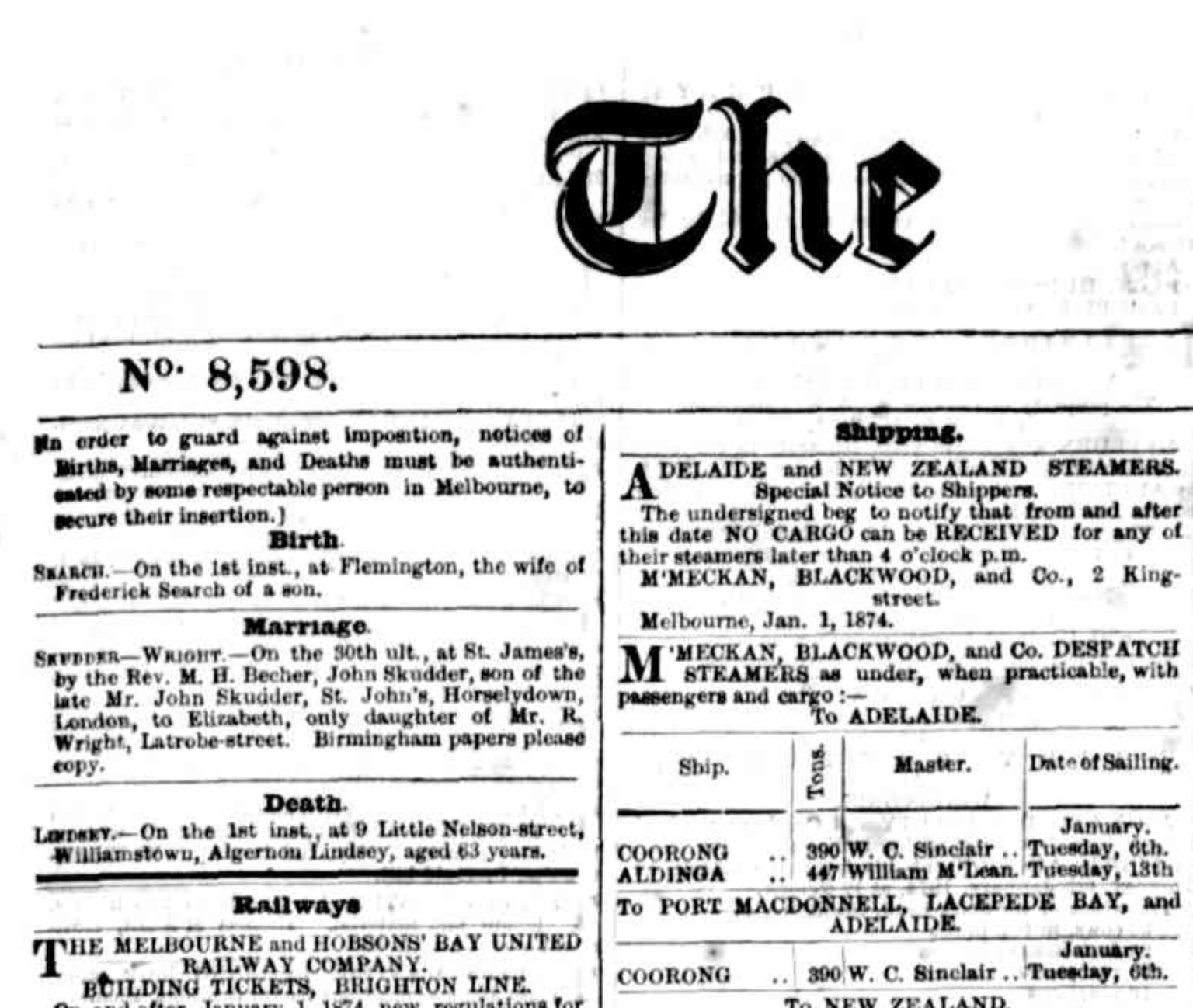
“Marriage Notice in The Argus of Jan 2, 1874: SKUDDER-WRIGHT. —On the 30th ult., at St. James’s, by the Rev. M. H. Becher, John Skudder, son of the late Mr. John Skudder, St. John’s, Horselydown, London, to Elizabeth, only daughter of Mr. R. Wright, Latrobe-street. Birmingham papers please copy.”
Thunderbolt! There it was in black and white, proof positive that THIS John Skudder, recently wed—evidently—to a woman named Elizabeth Edith Wright, whose parents hailed from Birmingham, England, was in fact OUR John Skudder who had more or less disappeared Down Under 174 years ago.
Wanting to prove it, though, to see for myself, I went to the Argus’ online archive. It was easy to find. Page 1 news, above the fold, top left.
From The Argus (Melbourne, Vic.: 1848 – 1957) Fri 2 Jan 1874 Page 1
Enlarging it…
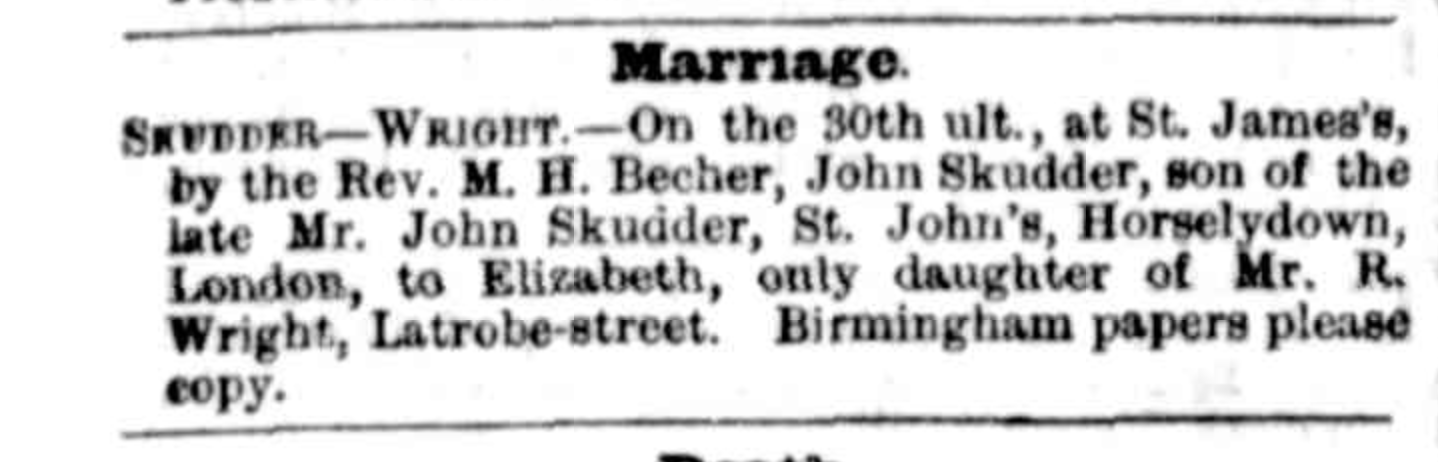
There it was, just as quoted on FindaGrave. Finally!
Continue reading
