Hon. William Prescott

The son of Col. William Prescott, also William, was known during his life, which was devoted to the law, as Hon. William Prescott. Here is a brief biography.
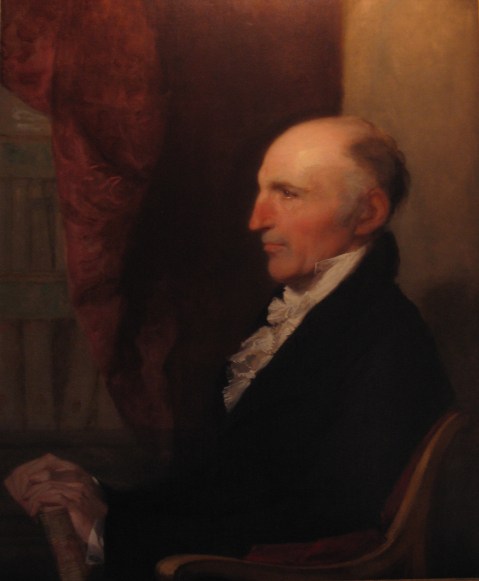
 

hon-wm-prescott-by-gilbert-stuart-alt1

Hon. William Prescott, painted by Gilbert Stuart

_______________

from the Prescott Memorial, pp.75-76.


Hon. William b. at Pepperell, Aug. 19, 1762. In 1776, at the age of fourteen, he was placed under the instruction of “Master Moody,” the then celebrated teacher of Dummer Academy in Newbury, Essex Co., Mass. Here he remained three years, when he entered Harvard College, where he graduated in 1783, with high honors. His father, partaking largely of that liberality so common among the officers of the Revolutionary army, had accumulated hut a small estate, and young Mr. Prescott found it necessary to be earning something to help him finish his professional education, upon which he was about to enter; accordingly he took charge of an academy at Beverly, where he continued two years, and where he studied his procession, (that of law,) with the Hon. Nathan Dane, an able and learned jurist and statesman. While here he received an invitation to become a member of Gen. Washington’s household, to act as a private teacher while he was prosecuting his legal studies, but. previous engagements compelled him to decline the proffered boon, and his classmate in college, Mr. Tobias Lear, obtained it.

Continue reading →

The Founding of Lawrence, MA

I found the following in a book on the history of textiles, and as per Uncle Johnny’s [John Endicott Lawrence, Sr.] feeling that this was “an event that merits close scrutiny,” I have enclosed here the first part of that account.


14310293_252957791765730_1056963093565015176_o

Lawrence Machine Shop, Lawrence, MA

____________________________


The history of the foundation and development of Lawrence bears close analogy to that of Lowell, save that one man instead of several conceived the enterprise and carried on the preliminary work necessary to its successful start.

Continue reading →

A Portrait of Family Life

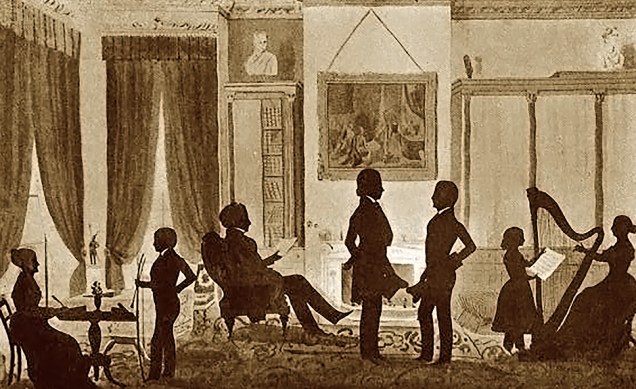
While of course Abbott Lawrence accomplished an enormous amount in business, and in civic life, and even international relations, he was also a husband and father. Here, as an assemblage of cut silhouettes, is a hint of his life at home, at No. 5 Park Street.

It is an image I enjoy immensely.


abbott-lawrence-family-sil-alt4

“The Family of Abbott Lawrence, In Their Library, 5 Park Street, Boston” by Auguste Amant Constant Fiddle Edouart, from Wax portraits and silhouettes, Massachusetts Society of the Colonial Dames of America, 1915

.

Continue reading →

Memorial to Abbott Lawrence Appearing in the NEHGS Register

The following account, dating from 1866, represents the most succinct telling of the life of Abbott Lawrence that I could find. For a longer, but slightly more relaxed read, see H.A. Hill’s Memoir of Abbot Lawrence.


abbott-lawrence


________________________

NEW ENGLAND

HISTORICAL AND GENEALOGICAL REGISTER.

VOL. X.                     OCTOBER. 1866.                                NO. 4.

MEMOIR OF THE HONORABLE ABBOTT LAWRENCE, LL.D.

THERE is something far more instructive in the lives of men who have been practically useful than in those of warriors and theoretical philosophers. Abbott Lawrence belonged to the former class. It is a great mistake in young readers to suppose that biography has no interest unless its subject has led armies, or suffered incredible hardships in some service which could never have been of any benefit to the world. The cultivated mind will turn from these to those of men who have really been benefactors to their own race, and will find their interest to increase in their perusal, in proportion as that mind becomes susceptible of what is truly great and of lasting importance.

Continue reading →

A Prescott Writes About a Lawrence

In the long  list of works by William Hickling Prescott, there is this: the Memoir of the Hon. Abbott Lawrence (available here at the Internet Archive).

It’s an interesting account, not least because it was written by another of our ancestors, but also, only somewhat off topic, because Prescott is the only researcher I know of (and I think, all things equal, he’s a pretty reliable one)  who definitively places Samuel Lawrence at Bunker Hill, in the thick of the fighting.

I think, also, that Uncle Johnny (John Endicott Lawrence, Sr.) must have read this account and really internalized it, as it contains several of the stories he related to me on my visits to him.

At any rate, have a read…


_______

.

MEMOIR

HONORABLE ABBOTT LAWRENCE,

PREPARED FOR THE

NATIONAL PORTRAIT GALLERY,

by

WILLIAM H. PRESCOTT, ESQ.

EXTRACTED FROM THE WORK BV PERMISSION OF THE PUBLISHERS.

PRINTED FOR PRIVATE DISTRIBUTION.

1856.

.


MEMOIR.


IN the following pages, we shall endeavor to present a sketch of the life and character of Abbott Lawrence, now that the grave has closed over him, and while his virtues are yet fresh in the memory of his countrymen.

The name of Lawrence is one of the earliest to be found among the Puritan settlers of Massachusetts. John Lawrence, the first emigrant of the name, was established in Watertown as early as 1635, and may have come over at the same time with Governor Winthrop. He afterwards removed, with his wife, to Groton, where lie lived to a good old age; leaving, at his death, a numerous family of sons and daughters. From one of the former was descended the subject of the present memoir. His father, Samuel Lawrence, was a soldier of the Revolution. On the breaking out of the war with the mother-country, he was among the first to bear arms; and was one of the little band of heroes who accompanied Colonel Prescott, and fought by his side at the battle of Bunker’s Hill. His regiment was accordingly in the hottest of the action; being stationed at the redoubt, the principal point of attack. It had nearly proved a fatal day to the young soldier, who, besides a wound in the arm, had his hat pierced by a musket-ball, which grazed his temples, and carried off part of the hair. He remained in the army till 1778, filling the post of adjutant under General Sullivan at Rhode Island. He was a man of much firmness of character, of unblemished integrity, and of such frank and open manners as made him popular with his townsmen. He lived till 1827; long enough to receive the best reward of a parent, in witnessing the complete success of his children.

Continue reading →

A Tribute to Abbott Lawrence From His Great-Great-Grandson

The following was written by James Lawrence (1907-1995) and appeared in his wife’s, Frances Weeks Lawrence’s, handwritten genealogy of the Lawrences.


geo-saunders-a-lawr-single

Portrait of Abbott Lawrence, from a Geo. Saunders miniature

_______________


Abbott Lawrence 1792‑1855 was an ancestor worthy of knowing, and with this in mind this briefest of sketches is offered to his descendants by one of his great-great-grandsons.

For Abbott Lawrence carved a position for himself in the history of 19th century Boston and New England such as few if any others achieved. He possessed energy, initiative, and unusual business acumen, but beyond that he had a tireless sense of public duty, as well as great personal charm of manner and speech which made him a most persuasive advocate and splendid citizen.

Continue reading →

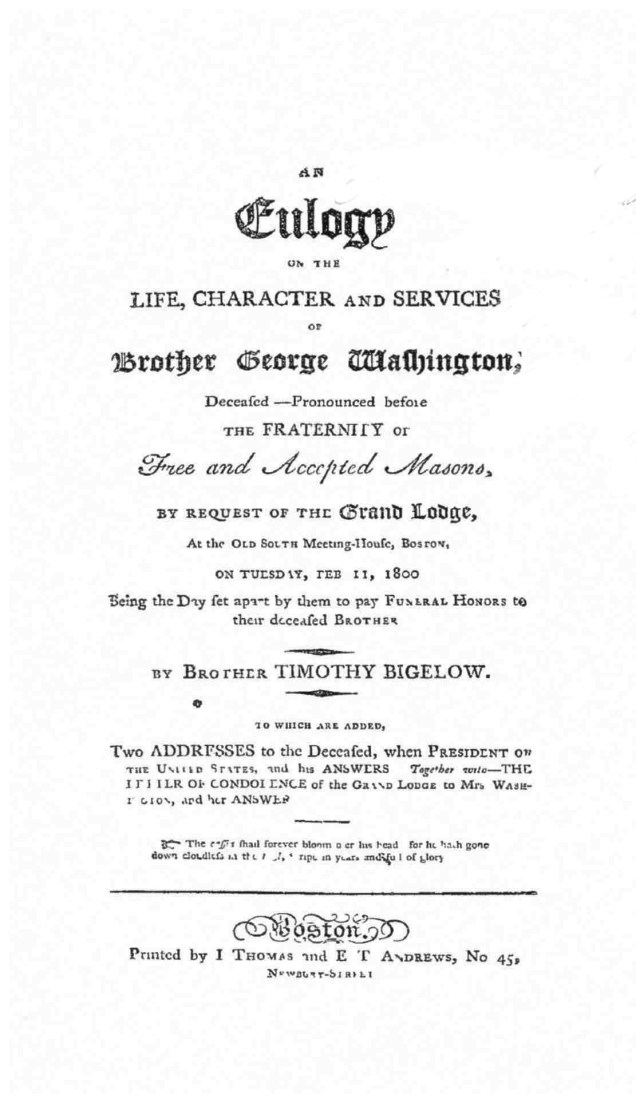
Timothy Bigelow, Jr.’s Eulogy for George Washington

Timothy Bigelow, Jr., the son of the Revolutionary War colonel, was, among other things, a prominent mason. When George Washington, who was a very prominent mason, died, Bigelow wrote this eulogy for his ‘brother.’

It’s the only substantive piece of his writing that I have found, and for that reason, not to mention the association with the father of our country, I thought it worth including.


____


t-bigelow-jr-eulogy-for-geo-washington_page_01a Continue reading →

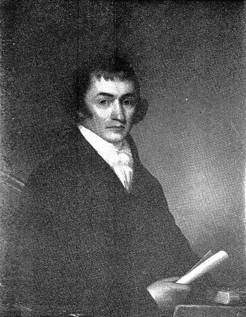
Hon. Timothy Bigelow

Moving now to the next generation below the Revolutionary War soldiers, we come to Timothy Bigelow, Jr., or as he would be known during his distinguished legal career, Hon. Timothy Bigelow. He is a transitional figure of sorts, as he too was also a soldier in the war, serving alongside his father at the tender age of twelve. Here, in brief, is his story.

Timothy Bigelow - But father or son?

A portrait of Hon. Timothy Bigelow, from his Masonic biography, available online, here.


__________

from The Bigelow Society Quarterly April 1986 Vol. 15, No. 2, p 29.


Worcester, Massachusetts has produced its share of illustrious Bigelows, none better known than Col. Timothy Bigelow of Revolutionary War fame. His son Timothy Jr. of Medford, MA was also well-known, and native to Worcester.

Timothy5 Bigelow, son of Col. Timothy4 (Daniel3, Joshua2, John1) and Anna (Andrews) Bigelow.

Born there 30 April 1767, he was a mere boy when his father became active in the war, so that the son was left to his mother’s upbringing. He entered a printing firm, but his interest lay more in the reading of, than the printing of, books. In 1778 he was sent to study with the Rev. Joseph Pope, but the following year, 1779, he joined his father in the Continental Army on the Rhode Island campaign.

Continue reading →

The Timothy Paine House in Worcester, MA

You can visit the house owned by William Paine, and his father Timothy (after whom it is named). It is maintained by the Daughters of the American Revolution, and is open to the public…


14115637_326619767672123_3662840372517385421_o

Website:

http://www.timothypainehousemuseum.org

Facebook Page:

https://www.facebook.com/pages/Timothy-Paine-House/112361542109909

or contact them at…

The Timothy Paine House Museum

140 Lincoln Street

Worcester, MA 01605

Tel: 508-797-3530

Google Maps:


Holy Cross has a nice write-up on the house and its history:


Colonial Society and its Legacy: William Paine’s House

“The Oaks”, one of the oldest surviving homes in Worcester is rich in both history, art, and culture. The building was begun in 1774 by Judge Timothy Paine (1730-1793), a member of the Colonial political elite. Judge Paine’s leanings were decidedly Tory as were those of his son William Paine (1750-1833) both Harvard graduates. With the advance of the American Revolution, Judge Paine deferred completing the residence, resigning his public roles to lead a quiet life in Worcester in his old house on Lincoln Street . It has long been suggested that Colonial troops occupied the house at some time in its unfinished state. William Paine who trained as a physician in Salem had married the social prominent Lois Orne of Salem in 1773, among whose wedding gifts was a lavish tea service by Paul Revere, the silversmith’s largest single commission. William left the country in 1774 after signing the infamous “Worcester Protest” (along with fifty other Worcester residents) arguing for the justice of British rule and continued his medical career in England and Scotland . He eventually served as surgeon general to the British army in North America . After the revolution he and Lois removed to Nova Scotia , moving back to Salem in 1787 when the ban against loyalists was lifted. They eventually returned to Worcester to settle into The Oaks after the Judge died in 1793.

Continue reading →