An Old Woman’s Memories of Col. Prescott

As Col. Prescott was a modest man of fairly humble financial means, there are no formal portraits, busts, etc. [Though, note, there is this.] A wonderful oral description, however, does survive… It is found in Beside Old Hearthstones, available online here.

__________________________

Some interesting facts are here added in regard to the personality of Colonel William Prescott, given by his grandniece, Mrs. Sarah (Chaplin) Rockwood, to Dr. Samuel A. Green. Her father was Rev. Daniel Chaplin, D.D., of Groton; and her mother was Susanna, eldest daughter of Judge James Prescott, brother of the colonel. She was ten years of age when the hero of Bunker Hill died.

She describes him as a tall, well-proportioned man, with blue eyes and a large head. He usually wore a skull-cap; and he parted his hair in the middle, wearing it long behind, braided loosely, and tied in a club with a black ribbon, as was common in those days. He had a pleasant countenance, and was remarkably social and full of fun and anecdotes. He was dignified in his manner, and had the bearing of a soldier.

Authorities agree on the value of early impressions; and we can but credit this description of the personal appearance of Colonel Prescott, for it was indelibly stamped upon the youthful Sarah Chaplin when sitting upon the knee of the old soldier.

…She attained the remarkable age of one hundred and four years.

The Sword of Bunker Hill NO CONNECTION

Bunker Hill: Maps, Art, Illustrations, Flags

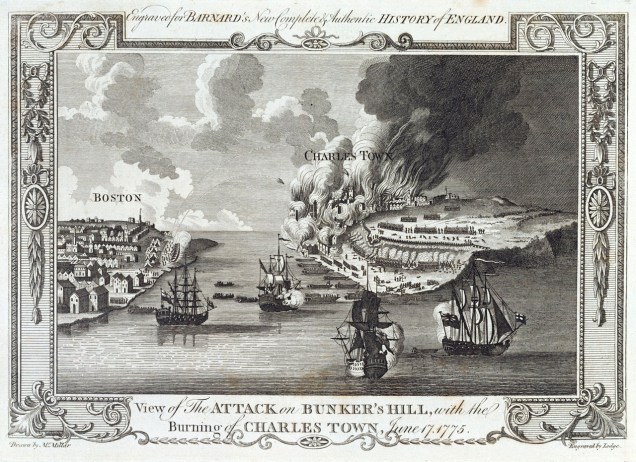
In the course of gathering material about Prescott and Bunker Hill, I’ve assembled a largish number of period artworks, illustrations, flags, photographs of statues, etc. Too many to place among the articles as tasteful visuals. So, I put them in two locations.

  1. You can see a few of them, as part of a montage, below.
  2. Or, you can check them all out as an album on the Facebook counterpart of this page,  here.

Continue reading

A Few Prescott Anecdotes

These are just some things I liked… Stories about Prescott.

Before we get to them, allow me a brief digression.

The dogged pursuit of names and dates and places of birth in genealogy really couldn’t interest me less. Taken on their own, they’re about as tantalizing as grocery receipts. Maybe a little more, but not much.

However, they do serve a purpose… And that purpose is not entirely dissimilar from the scaffolding material scientists and marine activists drop into the ocean to encourage the rebirth of coral reefs. Put the armatures in, and, the hope is, the life will find its way back.

It’s recollections like the ones below that are for me the living, breathing, color-filled reef of family history research…

30417928

Photographs, here and below, are of the statue of Prescott at the Bunker Hill Monument.

__________________

from the Prescott Memorial, pp. 58-9, footnotes,


Dr. Oliver Prescott, Jr., who was a nephew of Colonel William Prescott, and intimate in his family, and who was a young man at the time of the Revolution, had frequently heard his uncle, the colonel, relate a variety of anecdotes and incidents in his experience while in the army. He subsequently wrote sketches of the three brothers, (to wit) his father, Dr. Oliver, senior, and his uncles, Colonel William and Judge James, for his own use and amusement and that of his family, in which be has recorded many interesting anecdotes and incidents in their lives and experi­ence riot hitherto published, all of Which he saw or beard them relate. These sketches are now in the possession of his daughter, Miss Harriet Prescott of Cambridge, Mass., from which she has very kindly permitted the following extracts to be selected:

Continue reading

Who Really Was in Command at Bunker Hill? Prescott.

During the early 19th century, an idea took hold among a handful of academics that Col. Prescott was in fact NOT the American commander at Bunker Hill. He was. Writing near the centennial of the battle, Francis Parker was one of those who helped firmly establish the truth once and for all, and this was the article he used to accomplish that task.

A note on the references in this text…numbers occurring in parentheses represent the original document’s footnotes. Numbers in superscript following these are the new annotations for this site/ blog entry. –LSL

______________________


BUNKER’S HILL BATTLE

AND ITS COMMAND.

“Honor to Whom Honor is Due”

Francis J. Parker, writing c. 1875


By the first of June, 1775, the increasing numbers of the invest­ing forces, and their improved organization, had begun to create discomfort in Boston. Every avenue except that by sea was absolutely closed to supplies. Cattle, hay and fuel, which the British supposed to be safe on the islands in the harbor, had been captured or destroyed, and the loss of them was severely felt—more severely because of recent additions to the numbers of the beleaguered army, requiring an increased supply of food and forage. In these affairs about the harbor several spirited skir­mishes had occurred between the belligerents, and the result of them had been to give the Americans confidence in themselves, and to make the royalists more uneasy under their restriction. The British had therefore determined to occupy the Charlestown peninsula, which could easily be defended by works at the Neck, and the possession of which would give them considerable grass and pasture, and afford them another opportunity of sallying out by land.

Continue reading

A Letter from Col. Wm. Prescott to John Adams Describing The Battle of Bunker Hill

On August 25, 1775, William Prescott wrote a letter to John Adams, in which he described the Battle of Bunker Hill.

Both a photo of the actual letter, and the more readable text below, are available on The Massachusetts Historical Society’s website.

___________________


Camp at Cambridge August 25. 1775

Sir

I have recd. a Line from my Brother which informs me of your desire of a particular Account of the Action at Charlestown, it is not in my Power at present to give so minute an Account as I should choose being ordered to decamp and march to another Station.
Continue reading

The Battle of Bunker Hill, From Both The Land and The Sea

This account is from The Linzee Family, by John W. Linzee. It is particularly good in laying out the placement and respective roles of the British naval vessels involved.

The best few lines describe an exchange between General Gage and his subordinate, Willard:

Gage:“Who is in command of the Americans,” [and] “will he fight?”

Willard: “Yes, sir… he is an old soldier and will fight as long as a drop of blood remains in his veins.”

Gage: “The works must be carried.”

___________________


BH large


THE BATTLE OF BUNKER HILL

On the outbreak of the revolutionary conflict, Colonel William Prescott, a farmer of Pepperell, Mass., and a veteran of the Louisburgh expedition of 1746, also later with Winslow in the conquest of Nova Scotia, and known as a leader of dash and daring, attended on the 16th of June 1775 the secret call to arms on Cambridge common.

Already the Committee of Safety, in answer to their appeal, had collected from the New England towns about fifteen thousand men. Two regiments from New Hampshire were commanded by Colonel Stark and James Reed; three Rhode Island regiments under Colonels Varnum, Hitchcock and Church were on hand with General Green at their head; and three Connecticut regiments were led by Generals Israel Putnam, Joseph Spencer and Colonel Samuel H. Parsons. General Artemas Ward, the commander in chief of Massachusetts, was generally, though not officially, recognized as leader of the combined military forces.

The recommendation of the Committee of Safety to occupy Bunker Hill, was approved on the 16th of June. No time could be lost, as Generals Howe, Burgoyne and Clinton had reached Boston with reinforcements from England, and General Gage had determined to occupy Bunker Hill in Charlestown, which controlled Boston on the north, and Dorchester Heights which commanded Boston on the south, on or about the 18th of June.

A band of raw recruits, consisting of Prescott’s, Fry’s and Bridge’s regiments, about two hundred Connecticut troopers under Capt. Thomas Knowlton, and Capt. Samuel Gridley’s artillery company, were ordered by General Ward to proceed about nine at night, under the leadership of Colonel William Prescott, and to entrench themselves on Bunker’s Hill. The night was clear, a prayer for their safety by the Rev. Dr. Langdon, president of Harvard College, started them on their eventful march. They arrived at their destination in two hours, poorly armed and inadequately provisioned; the total force was a trifle over twelve hundred men, augmented when crossing Charlestown Neck by a few hundred reinforcements and General Putnam and Major Brooks.

Continue reading

The Alarm of April 19th: Pepperell and Groton

This account relates the colonists’ perspective, and is taken from Beside Old Hearthstones, available online at URL: http://www.usgennet.org/usa/ma/state/hearth/    It is obviously just a fragment, but a rather personal, and revealing one.

__________________


…The semiweekly drillings of the Pepperell minute-men under Colonel Prescott, and the bold statements from the pulpit by Rev. Joseph Emerson, kept the people in constant expectation; so that when the news of April 19 was received they were not long in making final preparations. A mounted messenger reached the town in the middle of the forenoon, declaring that the Regulars had come out from Boston, and killed eight men at Lexington, and were fighting at Concord. The despatch with which Colonel Prescott buckled on his sword, and bade wife and only son William, then thirteen years of age, a tender farewell as he galloped off the hill, may be known without resorting to imagination; for his habits of early years and later experience are in proof of this. His order was for the Pepperell company and that at Hollis to march at once to Groton, and there join the company of the latter town, while he proceeded directly to Groton. The effect of the more immediate contact with Colonel Prescott is seen in the report that the company from his town reached Groton before the men there were ready to march. The selectmen were then together distributing arms and ammunition to their soldiers. Dr. Oliver Prescott, chairman, brother of the Colonel, upon hearing the music and seeing the Pepperell company marching to the Common in full ranks, said, “This is a disgrace to us!”

Sarah Falder / Faulder / Foulder / Foulger / Faldez

The historian Samuel Eliot Morrison described Thomas Hickling’s second wife, Sarah, as coming from an old Portugese family. While her children all went on to marry Portugese people, their actual story is probably something along the lines of what is related below. (Interestingly, the Hickling name appears on far more Portugese genealogy websites than American.)

I don’t have much context to offer for the following email, posted on a family genealogy site in the late 1990s. It is from a researcher, Eloise Cadinha, to a Mr. Lothrop.

A version of this email, with only small changes, is currently available on the Ivens family blog.

____________________________

From: <XXX>
Subject: [PORTUGAL-L] Re: Thomas Hickling’s second wife.
Date: Fri, 18 Dec 1998 02:33:24 EST

Dear Mr. Lothrop:

I recently found in my files an article about Tomas Hickling, by Dr. Joao H. Anglin, a descendant.   It is from “Insulana” which is an organ of the Instituto Cultural of Ponta Delaga. The names in this article are written in Portuguese.

Tomas Hickling married twice. He married in 1764 in Boston, Sara Green, of Boston. 2 children were born to this marriage.

Continue reading

Hickling’s Letter to Washington; Jefferson’s Doubts

In 1790, Thomas Hickling sent a letter to George Washington, asking to be considered – at some point in the future – for the job of US Consul to the Azores and Western Islands. Thomas Jefferson, Washington’s Secretary off State, it  seems, had other thoughts….

The text of the letter is available at the National Archives website.

____________

To George Washington from Thomas Hickling, 10 January 1790

From Thomas Hickling

St Michaels Jany 10th 1790.


To His Excellency George Washington Esquire President of the United States of America,

The memorial of Thomas Hickling of the Island of Saint Michaels one of the Azores or Western Islands Merchant, Humbly Sheweth,


Continue reading

More on Thomas Hickling

The article below is a quick summary of Thomas Hickling’s life. It was written for Azores-Adventures, and posted May 5, 2014. It only briefly mentions Hickling’s second marriage to Sarah Falder. I’ll offer some more in-depth material on that in a post to follow.


_________

Thomas Hickling, a Yankee in the Azores


Thomas Hickling was an energetic businessman from Boston who moved to the Azores in 1770. He left in Massachusetts a wife and two children to start a new life in the Atlantic.

Not long after arriving in the archipelago, Hickling left a legacy that can still be visited today, including a rock with his name carved into it and the date “1770” near one of the hot volcanic pools in the spa town of Furnas, Yankee Hall, and the former Hotel Sao Pedro in Ponta Delgada.

Continue reading