Thomas Hickling and our Portugese Relatives

Continuing our look at the colonial forebears of the Lawrence family, we come to Thomas Hickling, the U.S. Vice Consul in the Azores during  the late 18th and very early  19th century.

(Hickling was also William Hickling Prescott’s maternal grandfather, and – obviously – the source of the historian’s middle name. It’s worth  noting that when the young William H. Prescott was recuperating from his eye injury at Harvard, he went on an extended tour of the world, and stopped to see his grandfather, still living, in the Azores. There he would have met his Portuguese cousins.)

The following is from an Ivens family genealogy site, accessed in the mid-1990s, and which sadly is now a dead link. It appears, though, that either the same author, or a family member connected to that author, has continued the site at a new URL.

(The text below has been lightly edited for clarity.)

_______________________

There is a register of the Hickling family in the first English national census of the population in 1273, but unfortunately it was impossible for us to establish any direct relation (that is believed to exist) between the names in that register and the one of William Hickling (1704-1781 ) born at Sutton Bonington, Nottinghamshire, who emigrated to Boston in North America in 1730 where he worked as a shipwright.

In 1734, he married Sarah Sale (1714-1782), great-great-granddaughter of the Elder Thomas Leverett (1585-1650 ) who emigrated from Boston, Lincolnshire to Boston in North America in 1633, and who is known to have had traced his descent to a man who lived in the reign of King John of England.

William Hickling and Sarah Sale were the parents of the mentioned Thomas Hickling. He [Thomas Hickling–LSL] was born in Boston, Massachusetts on February 21st 1745, and at the age of 19 he got married to Emily Green (1733-1774 ), by whom he had a son, William, who was married to Sarah Bradford (1769-1840), descendant of William The Conqueror, and a daughter, Catherine, who married Judge William Prescott and was the mother of the famous American historian William Hickling Prescott ( 1796-1859 ).

There were some radical ideological differences between William Hickling and his son Thomas. The first was, as was natural in an English gentleman, a stanch loyalist, whilst his son was an admirer of George Washington and a supporter of the revolutionary party. So, his father fearing that Thomas might put all the family in trouble, sent him abroad to Ponta Delgada where he arrived in 1769. He left his wife behind and never returned to America.
Continue reading

The Dedication of the Timothy Bigelow Monument in Worcester

Eventually, in the mid-19th century, the citizens of Worcester rediscovered Timothy Bigelow, and decided to right the wrongs of his death with a memorial.

The following is a contemporary description of the events surrounding the dedication. It includes, in addition to lists of all the dignitaries and fire companies and Bigelow relatives present, a detailed description – in typical 19th century fashion – of the exhumation of his grave, and the careful inspection of his remains.

Reading it, you can almost imagine how Mark Twain would have described the affair. How times had changed! I wonder what the Colonel  would have thought.

_______________

available online at http://www.massdar.org/bigelowmonument.html

and originally from History of Worcester, Massachusetts: From Its Earliest Settlement to September 1836, by William Lincoln, published in 1862.


City of Worcester,

Whereas, by a resolve of the City Council, passed Dec. 23, A. D., 1859, leave was granted to Timothy Bigelow Lawrence to erect a Monument over the remains of Colonel Timothy Bigelow; and, by said resolve, the Mayor was empowered to designate a suitable lot for that purpose, where said remains now lie, — the same not to include the remains of persons of any other family; and it was further resolved, that said lot be forever appropriated and devoted to said purpose —

Continue reading

The Life of Timothy Bigelow, Crowdsourced


Rounding out these readings on Col. Timothy Bigelow is his Wikipedia entry. I am not including the entries from Wikipedia for most of our more famous ancestors, but here I’m making  an exception. The description of the incident with the British spies, as well as the expedition under Arnold to Quebec, and the log entry of his jailer noting that he had been discharged “By Deth” provide justification enough.

___________

from Wikipedia

Timothy Bigelow (August 12, 1739, Worcester, Massachusetts – March 31, 1790, Worcester)

Timothy Bigelow was born on 2 Aug 1739 in a part of Worcester known as Pakachoag or College Hill, located in Worcester County, Massachusetts, USA. son of Daniel Bigelow and Elizabeth Whitney. Timothy Bigelow’s father was a farmer, the owner of 100 acres of land on “Little Packachoag Hill.” Timothy and his brothers grew up in the ways and manners of the times. Chores, assisting their father and in “off hours” the boys enjoyed swimming and fishing in the summertime, fishing in the winter, because a stream, called the French River, divided the northerly section of the farm.

He was early apprenticed to the blacksmith trade, and carried on that occupation most of his life. He was self-educated, and as a young man was widely-read, became a fluent speaker, and accumulated a little library. Future President John Adams was Timothy’s teacher. He was known locally for his prowess at debating. In the rear of the Andrews home Tim Bigelow had a blacksmith’s shop where he blew the bellows, heated and hammered the iron, and shod the horses and oxen and mended the plows and chains for the farmers of the country about him. As described in the history books, Tim was as bright as a button, more than six feet high, straight and handsome, and walked upon the earth with a natural air and grace that was quite captivating.

Continue reading

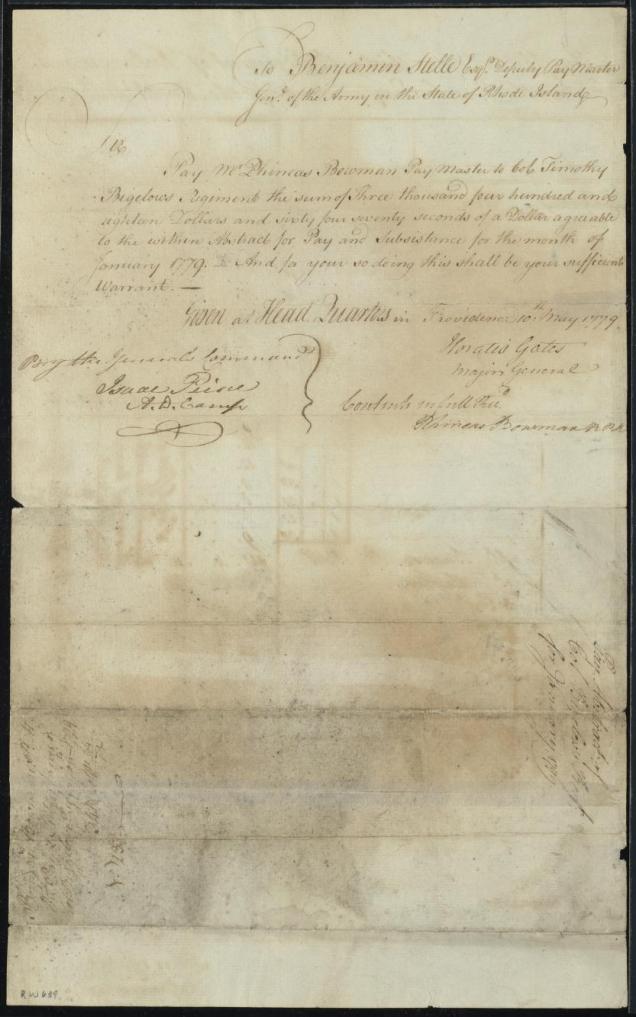
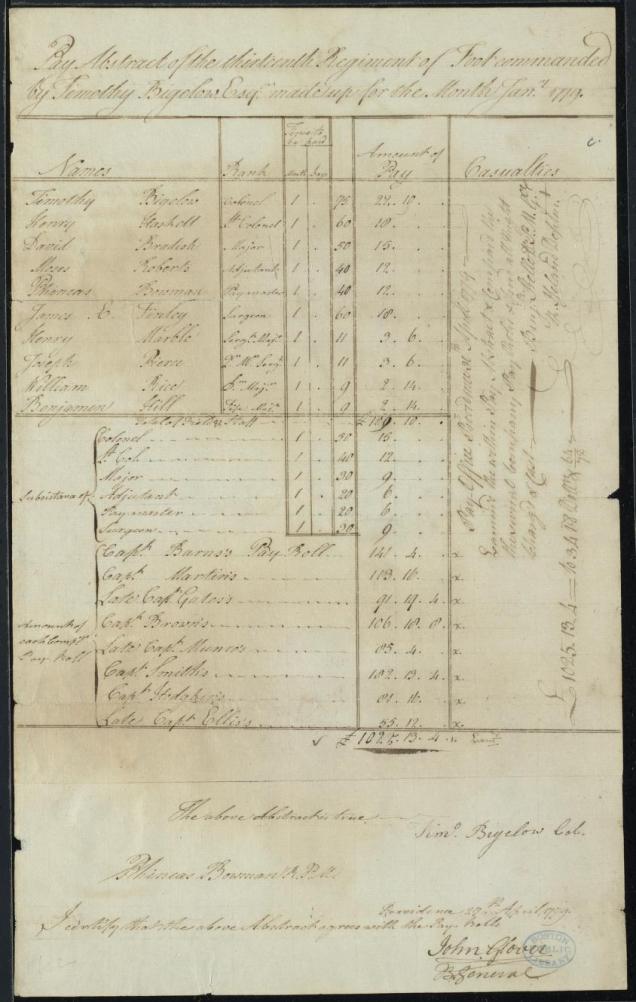
The Muster Roll for the Thirteenth Regiment of Foot, commander Timothy Bigelow

I recently came across this at the excellent website, Archive.org. It is the muster roll for Timothy Bigelow’s regiment. The original entry is here.

____________

Muster roll for the Thirteenth Regiment of Foot, commander Timothy Bigelow [manuscript]

 by Bigelow, Timothy, 1739-1790; Glover, John, 1732-1797; Boston Public Library. American Revolutionary War Manuscripts Collection; United States. Continental Army. Massachusetts Regiment, 15th
Dated: Providence, Apr. 27, 1779

Holograph, signed

Pay abstract for the month of January, 1779

Signed by John Glover, B. General

The Boston Public Library’s American Revolutionary War Manuscripts Collection

muster-roll-for-the-thirteenth-regiment-of-foot-commander-timothy-bigelow-manuscript-1
muster-roll-for-the-thirteenth-regiment-of-foot-commander-timothy-bigelow-manuscript-2

Reminiscences of the Military Life and Sufferings of Col. Timothy Bigelow

Last year, I was lucky enough to happen across the actual war memoirs of Col. Timothy Bigelow, as recalled by his family. It’s the most detailed account I have located of his service, and worth reading in its entirety.


_______________________________

REMINISCENCES

OF THE

MILITARY LIFE AND SUFFERINGS

OF

COL. TIMOTHY BIGELOW,

COMMANDER OF THE FIFTEENTH REGIMENT OF THE MASSACHUSETTS LINE IN THE CONTINENTAL ARMY, DURING

THE WAR OF THE REVOLUTION.

BY CHARLES HERSEY.

WORCESTER

PRINTED BY HENRY J. HOWLAND,

212 Main Street.

1860.


INTRODUCTION.

The writer of the following pages was dandled upon the knee of a worthy sire, who had spent eight years of his life in the struggle for Independence, and taught me the name of Col. Bigelow, long before I was able to articulate his name. Many have been the times, while sitting on my father’s lap around the old hearthstone, now more than fifty years since, that I listened to affecting reminiscences of Col. Bigelow and others, until his voice would falter, and tears would flow down his aged and careworn face, and then my mother and elder members of the family would laugh, and inquire, “what is there in all of that, that should make you weep?” but I always rejoiced with him, and wept when I saw him weep. After the death of my father, having engaged in the active scenes of life, those childish memories in some degree wore away, but the happiest moments of my life have been spent in company with some old Revolutionary Patriot, while I listened to the recital of their sufferings and their final conquest.

Continue reading

An Account of Timothy Bigelow’s Courtship and Marriage

This is an account of Bigelow’s life, his wife’s genealogy, and perhaps most interestingly, his courtship and marriage.

____________

from the site Revolutionary Oaks, The History of the Colonel Timothy Bigelow Chapter in Worcester, Massachusetts, of the National Society of the Daughters of the American Revolution:


TIMOTHY BIGELOW ROMANCE

by Jeanette A. W. Ramsay, D.A.R.

March 9, 1909


Among the Scotch settlers in Worcester, there came over an Irish family by the name of Rankin.  They had several daughters, the youngest of whom was Anna — beautiful Anna Rankin!

At that time there was a family here, very respectable for the times, by the name of Andrews. One of the boys was named Samuel, who was at the time an undergraduate in Harvard College.

Samuel came home to spend a vacation and while at home he saw Anna Rankin and taking a liking to “her neck,” which, like Kathleen Bawn’s, was “so soft and smooth without a freckle or speck,” he “fell in love,” as the novel-writers say.  He forthwith threw Latin and Greek to the dogs, mad love to Anna and in due time married, and purchasing a farm on the west side of Quinsigamond Lake, he settled down and became an industrious and frugal yeoman.

In that occupation he prospered so well that in a few years he quitted his farm and moved to the village, and built him a house on the very spot where the stone jail was subsequently erected (on the corner of Lincoln square and northwest corner of Summer Street).

Afterward he built him a larger and better house on the ground now occupied by the block of brick houses, opposite the Courthouse. (Please note the locality.  Lincoln in his History gives it so, page 281, also using the word “dwellings.”)

Father and mother both died, leaving an only daughter named Anna, after her mother Anna Rankin, with an estate that made her the principal heiress of Worcester in those times.

In the rear of the Andrews house, “Tim” Bigleow had a blacksmith’s shop where he blew the bellows, heated and hammered the iron, shod the horses and oxen, and mended the ploughs and chains for the farmers of the country about him.

Now Tim “was as bright as a button,” more than six feet high, straight and handsome, and walked upon the earth with a natural air and grace that was quite captivating.

Tim saw Anna and Anna saw Tim and they were well satisfied with each other.

But as he was then, nothing but Tim Bigelow, “the blacksmith,” the lady’s friends, whose ward she was would would not give their consent to a marriage.  So, watching for an opportunity, the lovers mounted fleet horses and rode a hundred miles to Hampton, in New Hampshire, which lies on the coast between Newburyport and Portsmouth, and was at that time the “Gretna Green” for all young men and maidens for whom true love did not run a smooth course in Massachusetts.

They came back to Worcester as Mr. and Mrs. Timothy Bigelow.

Continue reading

The Life of Col. Timothy Bigelow as Recounted in the History of Worcester

The title says it all. The man’s story almost reminds me of Mozart and his relationship with Vienna. A leading citizen of a city. An influential, highly regarded man. Active life. Hard times. Ignominy. Death as pauper, at a youngish age. Resurrection, in reputation if nothing else. Monuments, ceremonies, and shared pride once again in the man their fathers and grandfathers had treated so badly.

____________________

from History of Worcester, Massachusetts, from its earliest settlement to September, 1836; with various notices relating to the history of Worcester County, by Willam Lincoln, Worcester, 1837. Ebook available here.


COL. TIMOTHY BIGELOW

Col. Timothy Bigelow, was born in Worcester, August 12, 1739. His father, Daniel Bigelow, was of that class of substantial farmers who have been distinguished here for independence, good sense, industry and probity. [1] The youngest son, the subject of this sketch, was first apprenticed to a mechanic trade, and afterwards prosecuted the business of a blacksmith with diligence.[2] He was soon ranked among the most energetic and prosperous of the young men of the village. With strong native power, and shrewd observation of men and things, he labored to supply the want of the advantages of education: he collected a small but well selected library, became acquainted with some of the best English authors, and gained the art of speaking with directness and force, and of writing with point and accuracy. These acquisitions were soon called into full exercise.

Continue reading

Col. Timothy Bigelow: An Introduction

Col. Timothy Bigelow (1739-1790) is one of the most fascinating and utterly admirable people I have come across in my exploration of our ancestors.

Timothy Bigelow

  • In his youth, he was tutored by John Adams, the future patriot and U.S. president.
  • In his twenties, he eloped with his heiress fiancee, riding with her on horseback to a clandestine ceremony more than a hundred miles away in Hampton, New Hampshire.
  • In his early civilian life, he was a blacksmith, but his passions ran to the political issues of the day, and from the political to the military.
  • He was a member – in the run up to the revolutionary period –  of the Committee of Correspondence.
  • He was an early member of the Sons of Liberty, a clandestine loose affiliation of colonists dedicated to resisting British rule.
  • He was a delegate to the Massachusetts Provincial Congress for its first two sessions.
  • He was the first, unanimously chosen, commander of the Minute Men of Worcester, and marched with them following the call to the Battle of Lexington and Concord.
  • In the Continental Army, he served under, among others, Arnold, Gates, and Lafayette.
  • He fought – seemingly – everywhere: at Quebec, Monmouth, Saratoga, Verplanck’s Point, Peekskill, Valley Forge, and Yorktown, and was present at the surrender of Burgoyne.
  • He was captured and held as a prisoner of war, by the British in Canada, before being exchanged back.
  • He retired a full Colonel.
  • Following the war, Congress granted him 23,040 acres of land in Vermont, in lieu of money, on which was founded the town of Montpelier, VT; he never saw the grant, however.
  • He returned to civilian life almost certainly suffering from what is today called PTSD. The description of his symptoms, written in the vernacular of the 18th century, is both absorbing and heart wrenching.
  • Following the death of his teenaged son, he developed a severe depression, and, financially destitute, died in debtor’s prison at the age of 5o.

In the next several posts, I’m going to reproduce a number of the materials I have found on this man: admittedly, some of it is a little dry, some of it repeats what has appeared elsewhere, but…each item offers something unique as well: some new anecdote, a letter from his wife, the entry of his jailer on his death, etc.; together they present multiple perspectives on an individual whom – I believe – history needs to acknowledge once again.

Continue reading

The Old Burying Ground and the Groton Cemetery

Our earliest Groton ancestors, i.e. Lawrences, Tarbells, Parkers, and others who preceded Samuel and Susanna Lawrence, are interred in the Old Burying Ground in the center of town. (Many of the graves are worn and illegible, but  Samuel Abbott Green compiled an interesting book of the headstone inscriptions there, Epitaphs from the Old Burying Ground in Groton, Massachusetts.) The Old Burying Ground is located here.


Our more “recent” kin, recent by New England standards, starting with Samuel and Susanna Lawrence, are buried in the Groton Cemetery, a little further towards the outskirts of town.


Both of these places are well worth the trip.

William Lawrence on His Grandmother, Susanna Lawrence

This next passage, which closes out the material on Samuel and Susanna Lawrence, is devoted exclusively to Susanna. I have always thought she would have to have been an amazing woman. She managed a household with a husband away at war; was herself a currier for secret correspondence; delivered and raised 9 children in a pre-vaccination/ pre-antibiotic era with one child dying in his teen years and the other eight surviving to adulthood; and lived to the somewhat extraordinary age of 89.

____________________

from Extracts From The Diary And Correspondence of Amos Lawrence, by William R. Lawrence, M.D., Boston, 1855

Of his mother Mr. Lawrence [Amos–LSL] always spoke in the strongest terms of veneration and love, and in many of his letters are found messages of affection, such as could have emanated only from a heart overflowing with filial gratitude. Her form bending over their bed in silent prayer, at the hour of twilight, when she was about leaving them for the night, is still among the earliest recollections of her children.

She was a woman well fitted to train a family for the troubled times in which she lived. To the kindest affections and sympathies she united energy and decision, and in her household enforced that strict and unhesitating obedience, which she considered as the foundation of all success in the education of children. Her hands were never idle, as may be supposed, when it is remembered that in those days, throughout New England, in addition to the cares of a farming establishment, much of the material for clothing was manufactured by the inmates of the family. Many hours each day she passed at the hand‑loom, and the hum of the almost obsolete spinning‑wheel even now comes across the memory like the remembrance of a pleasant but half‑forgotten melody.