Connecting Joseph Weld’s Land Grant to Allandale Farm

A few months ago, my aunt, Lee Albright, asked me what we could and couldn’t say with historical accuracy on the subject of the Weld origins of the land Allandale Farm now sits on.

I actually ended up sending her a succession of emails in reply. The problem was that I initially found multiple statements online that I credulously believed; but as I dug deeper, it became apparent that there are large gaps of knowledge. And some or much of what is available online is simply wrong.

Eventually, I came up with the following, which I think is pretty solid, historically speaking, but then again, I’ve already been wrong on this several times.

The land that is home to Allandale Farm and The Apple Orchard was given as part of a larger grant from the Massachusetts colonial legislature to Capt. Joseph Weld, in the mid-1600s. It has been continuously farmed by descendants of the Weld family since the late 19th century.

Continue reading

Joseph Weld’s Will

This is the document to which Isabel Anderson referred, the last will and testament of Capt. Joseph Weld.

______________


(Weld Mss. with the N. E. H. & G. S.) 1646.

Ipswich, this second day of the fourth month. (june).

Being visited by the hand of the Lord, and not knowing what the purposes of God may be; my spirit being restless and out of quiet because my house is not set in order, I think it my duty to go about the work having first sought to God for direction; and though I cannot do it so well as I might had I been at home, yet because I know not whether ever I shall return, I do therefore make this my last will and testament as followeth.

Continue reading

The Treaty Joseph Weld Orchestrated with the Pequots

This is it—the text of the treaty the colony was so grateful for that they gave Capt. Joseph Weld the land grant. As such, it is the ultimate upstream origin of Allandale Farm, though I will have more to say about that in a later post. (Things are not as straightforward as some online sources make them seem.)

_______________


(R. of Mass. Bay II: 40-1)


This writing is to testify that wee, Pumham, sachem of Shawomock ec. & Sacononoco, sachem of Patuxet ec., have & by these psents do volentarily & wthout any constraint or pswasion, but of or owne free motion, put orselues, or subiects, lands, & estates under the govrmt & iurisdictio of the Massachusets, to bee govrned & ptected by them according to their just lawes & ordrs, so farr as wee shalbee made capable of understanding them; & wee do pmise for our selues, & all or subiects, & all or posterity, to bee true & faithfull to the said governmt, & ayding to the maintenance thereof to or best ability, & from time to time to give speedy notice of any conspiracy, attempt, or evill intension of any wch wee shall know or hear of against ye same; & wee do pmise to bee willing from time to time to bee instructed in the knowledge & worship of God. In wtnes whereof wee have hearunto put or hands, this 22th of the 4th mo. 1643.

Continue reading

The Early Welds

The name Weld, probably derived from the word “wild,” first appeared in its current form with William Weld, the High Sheriff of London, in the year 1352. It is difficult, however, to trace cleanly the various family lines, as they move in and out of obscurity, and William may or may not have been an ancestor of ours.

The first definite point of contact we have is with a Weld, Christian name  or first name unknown, born before 1500, who in turn was the father of John Weld “The Elder.” From him, we can move to Thomas and Joseph Weld, the founders of the Weld family in America.

The book Weld Collections by Charles Frederick Robinson is the definitive source on this family, both in depth and breadth of information. For sheer succinctness and readability, however, Isabel Anderson easily wins out. The following is a brief excerpt from her description of why these two men came to America, and how they initially faired.

_________________

from Under the Black Horse Flag, by Isabel Anderson..


…Apparently, however, a branch of this family were Puritans, one of whom, the Reverend Thomas Weld, had been educated at Trinity College, Cambridge, and settled as Vicar of Terling, Withem, Essex, where four sons were born to him. In the latter part of 1629, Laud, afterwards Archbishop, the great enemy of the Puritans, began his persecution. Thomas Weld was excommunicated and charged to depart, evidently to his deep indignation, for his friend, the Reverend Thomas Sheppard, writes: ‘Mr. Weld and other ministers consulted together whether it were best to let such a swine root up God’s plants in Essex.’

But the wisest thing for the Reverend Thomas Weld to do under the circumstances was to get into Scotland and from there escape to New England, ‘it being impossible to leave direct without being arrested, if discovered.’ The two clergymen, Sheppard and Weld, had already resolved upon this course, when, being in the neighborhood of the church where Laud was preaching, they drew near, probably out of curiosity, to listen. Laud, coming out of the church suddenly, found Thomas Weld standing upon churchly territory, a thing which he had no right to do because he had been excommunicated. The Archbishop challenged the Puritan and, in an interchange of angry words, accused him of intending to go to New England, and Weld instantly admitted it. ‘Hereupon he was committed to the Puirsuivant and bound over to answer it at the High Commission on a bond of 100 marks.’

He managed to escape, probably by forfeiting his bond, and with him sailed not only his brother, Captain Joseph Weld, but Joseph’s wife, one son and three daughters, and John Winthrop, later Governor of the Plymouth Colony. Suffolk, England, was the early home of all of them (the earliest date to which the ancestry of the American line can be traced with certainty is that of John Weld of Long Melford County, Suffolk who died in 1551) and no doubt the long friendship of Governor Winthrop and Thomas Weld had begun in their English youth.

There were some sixty‑five men who sailed on the ship William and Frances from London, March 9, 1632, although the clearance list at the Custom House only gives the names of about twenty. Ministers and men of position and prominence were not allowed to leave England, and could only make their way out of the country secretly. They landed in Boston early in June, and within a month Thomas Weld was installed as the first pastor at the First Church in Roxbury. Later he became one of the first Board of Overseers of Harvard College.

__________________________

Captain Joseph Weld, the Reverend Thomas Weld’s brother, and the real founder of the American family of Weld, had arrived on the same ship, as the reader well remember, bringing his wife, one of his sons, and his three daughters. Another son followed him six years later. Being well trained in military affairs, Captain Joseph Weld was a valuable aid to Governor Winthrop and served in numerous fights with the Indians, as well as being one of the Commissioners to make a treaty of peace with the Pequots.

In company with other prominent men in the Colony, he was given a grant of three thousand acres at Braintree for the ‘encouragement of Iron Works to be set up there.’ For his personal estate the Colony gave him several hundred acres in Roxbury. All the district, from what is now Dudley Street to the outlying sections of West Roxbury, was then included in the one name Roxbury

His son John settled on this Roxbury grant, while his father remained at his earlier dwelling on Roxbury Street in what is now Jamaica Plain. He made many journeys to England on business and prospered. He was one of the first donors to Harvard College, and Savage states that at the time of his death he was the richest man in the Colony. Not only John Weld fought against the Pequot Indians in 1676 in King Philip’s War but both his sons and his grandsons also were officers in the service of the Colony. Governor Winthrop mentioned his death as a great loss to the settlement. The Apostle Eliot, his particular friend, says in his journal that the Captain died of cancer of the throat and jaws. Before leaving on his last journey to England, while in the town of Ipswich, Joseph Weld made his will; though contrary to his own expectations, he did live to get back to America.

The will begins as follows: ‘Being visited by the hand of the Lord, and not knowing what the purposes of God may be; my spirit being restless and out of quiet because my house is not set in order . . . I do therefore make this my last will and testament.’ After giving directions for a sum to ‘the college at Cambridge’ and allotting the house, the barns, the arable lands, and the marshes among his children, he proceeds to smaller details. Each of the children by his first wife was to have a pair of sheets; each might choose a book from his library; his son John was to have his best stuff suit and his cloth cloak, Thomas his frieze suit. But his friend, John Eliot, was willed the pride of his wardrobe, his black tamey cloak. His second wife was to get the down bed and bolster, and all the things belonging to the best chamber, including ‘the yellow rugg and the largest green rug”.’ The will ends with many codicils showing how carefully the good man desired to do full justice to all his children and to show appreciation to the executors, whom he remembered at the last with ten pounds each, a very good sum in those days…

Rediscovering Both a Painting and a Face: Martina Louisa (Condict) Brandegee, by Cecilia Beaux c. 1903

They say there are several deaths. The death of your body. The death of the last person who could remember you when you were alive. And, the last moment anyone speaks your name.

I think we could add to this list, perhaps near but not at the end, the death that occurs when your actual appearance is forgotten.

Continue reading

Grace Church, Utica, N.Y.


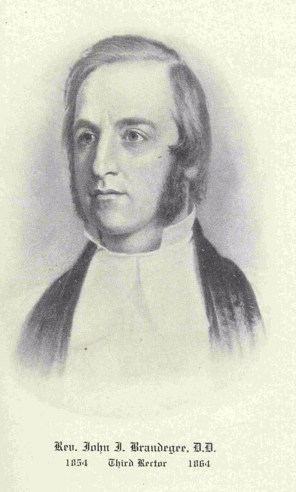
No description of John J. Brandegee’s life would be complete without a specific mention of the church he helped found, Grace Church, in Utica, N.Y.

grace-episcopal-church-utica

A passage from the church’s history reads:

The cornerstone was laid on July 10, 1856, but by September 1859, it seemed as if the edifice might never be completed due to financial problems. However, the Rev. John J. Brandegee, third rector, was a man of great courage and experience and it was through his persistence that enough money was raised to finish the church and pay off the mortgage. On May 20, 1860, the first service was held in the new church and on Easter Day, 1864, the $30,000 mortgage was paid. The church was consecrated on August 16, 1864, but unfortunately, Dr. Brandegee died a week after presenting the last offerings which freed the church from its debt. Truly it may be said of him that “…his real offering was himself, and that the church is his enduring memorial.”

Today, the church is still going strong, and actually houses several portraits of Brandegee, a bust of him, as well as one of the few extant contemporary copies of his book of sermons.

[Note: I have extremely low resolution photos of these portraits, kindly sent to me in the mid 90s by the church’s minister or perhaps historian, which I debated putting up here. The reproductions really need to be redone from the originals, though, in good lighting, with modern camera technology; even an iPad would probably be fine. A project for another day, however.–LSL]


_______


The location and contact details for Grace Church are as follows:


Website for the church is here.

Facebook page is here.

Wikipedia entry is here.

An online walking tour can be viewed here. Note there are some irritating pop-up ads with this, but I still enjoyed it.

Lastly, you can get in touch at:

6 Elizabeth St,

Utica, NY 13501

Tel: (315) 733-7575


Google Maps:


Rev. John J. Brandegee Marries Miss Martina L. Condict

I found this in  NYC Marriage & Death Notices 1843-1856, available here. It is a contemporary announcement of the marriage of Rev. John J. Brandegee to Martina Condict. Since the marriage took place in New Jersey, I presume the notice was placed for social purposes and has no legal value.


Overview…

img_9322

Closeup…

img_9326


The text of the entry reads: “MARRIED 1852: On Tuesday evening, June 1st, at St. Peter’s Church, Morristown, by Rev. Charles W. Rankin, Rev. John J. Brandegee, Rector of St. Michael’s Church, Litchfield, Conn., to Miss Martina L. Condict, daughter of Hon. Lewis Condict, of this Town.”

I have to confess it was fun to find this. Why? Really, it’s just an entry of an old fact in a decrepit, crumbling, little book of old facts. Perhaps because it reminds me there was a time when their marriage was actually news. Nothing of their lives together was “written.” And people, hearing of this, felt hope and good cheer.

Rev. John Jacob Brandegee

The following brief biography of Rev. John J. Brandegee (Edward Deshon “Ned” Brandegee’s father) is taken from the book, Genealogical Record of the Condit Family, Descendants of John Cunditt, 1678 to 1885,  by Jotham H. Condit and Eben Condit, Newark, 1885, pp.233-4, available online here and in paperback here; also reprinted in Condits and Cousins: The Condits and Their Cousins in America, Vol.6, edited by Norman I. Condit, Owensborough, KY, 1980—LSL

[An additional note, you can read Brandegee’s collected sermons online, here. I also have a .pdf of them which I will eventually post.–LSL]

____________

jjb-for-printing

A sketch of Rev. John J. Brandegee.


MARTINA L. CONDIT (Condict) (of Dr. Lewis) married. June 1, 1852, Rev. John J. Brandegee, D. D., who was born at New London, Conn., July 25, 1823. He was the son of John and Mary Brandegee, one of whom was of Dutch and the other of French extraction. Both families had long previously settled in this country. Dr. Brandegee spent his early youth at New London, and in 1843 graduated at Yale College with a high reputation as a scholar. He was confirmed by Bishop Brounell at New Haven, at the age of 18. Before graduating he formed the purpose of studying for the ministry, and on Sept. 27, 1843, he entered the General Theological Seminary, at New York City, where he completed his course of preparation, and was ordained a deacon by Bishop Brownell, July 3, 1846, at Hartford, Conn. After his ordination he went with an invalid brother to the West Indies, where he labored for two years. On his return he was ordained to the priesthood, Jan. 24, 1849, by Bishop Henshaw, of Rhode Island, at New London, Conn. At this time he was laboring in the parish of St. Michael, Litchfield, Conn., where he continued until February 4, 1854. He then entered upon his duties as rector of Grace Church, Utica, N.Y., and remained there during life, though repeatedly invited to other attractive fields. In the ten years of service at Utica his labors were abundantly blessed, and to his efforts may be credited the erection of the beautiful edifice now occupied by the parish of Grace Church. The cornerstone was laid in July, 1856, but the church was not opened for divine services until May 20, 1860. The last two years of Dr. Brandegee’s labor was frequently interrupted by sickness, which finally resulted in his death April 6, 1864. In 1867 his widow published a volume of sermons which he had preached at different periods of his ministry of eighteen years. They indicate a mind of uncommon intellectuality and breathe a spirit of true devotion to the service of the Master.  She died Dec. 11, 1904.

Continue reading

Martina Elmendorf’s Diary, 1802

In August of 1802, Martina Elmendorf (who would go on to marry Lewis Condict) started a diary… Perhaps diary is not the exact right word. It seems to be a combination of a calendar and a sort of serial acknowledgement/ recitation of what she was learning in school and church. But diary will suffice.

I confess at the outset, I have not read it in any detail. My main effort, so far, has simply been to get it reproduced and available to others, and hopefully ensure its survival – beyond the reach of fire and flood –  into the future.

Consider this a place holder. I’ll post more when I have it.


_______


img_0008


Continue reading

The Zabriskie Mansion House, Once Washington’s Headquarters, Lost to Development

The house in which Judge Peter Zabriskie (Martina Elmendorf’s grandfather) lived with his family was said to be one of the most beautiful in Hackensack.

Built in 1751, and located on the north side of the Green at 50 Main Street, it was known by all as The Mansion House, and served as headquarters for George Washington from November 15-November 20, 1776. I have often wondered what Peggy Zabriskie Elmendorf might have remembered from that period in which her home was transformed into the general’s command post. It must have been something…


bank-house-large

A view of Hackensack c.1831: the house was located in the cluster of buildings to the right of the church tower


Upon Peter Zabriskie’s death, the house was probably passed to his daughter and son-in-law, Peggy – Margaret – and John Elmendorf. In 1815, following their deaths, the house was sold to Dr. David Marvin, a physician.

Continue reading