John Endicott Lawrence, Sr., as Remembered By His Children

Uncle Johnny’s memorial service, May 13, 2007, stands out in my mind in an almost singular way. It was a glorious spring day, and people from all over the world had come to pay tribute to him. There wasn’t a hint of sadness or morose sentiment– at least that I detected. Just a collective marveling at this…spirit…that we had been lucky enough to know. His three children, Susanna, Jack, and David, all spoke.

Here is the program we followed and sang from, followed by their thoughts, as delivered…..


______


jel-pgm-side-1

Continue reading →

John Endicott Lawrence, Sr.: His Globe Obituary

After John Endicott Lawrence, Sr. died, the following obituary appeared in the Boston Globe.

In posts to come, I will offer remembrances by family members, as well as a biographical sketch written, while he was alive, by his (then) thirteen year-old great-grandson.

For now, consider this the briefest of introductions to a remarkable, wonderful man.

__________

from the Boston Globe…


John Endicott Lawrence


Died at home surrounded by his family in Hamilton on March 27 at the age of 97. The last living member of the staff of Admiral William (Bull) Halsey, he was present at the surrender of the Japanese in Tokyo Bay in 1945. But, this was only one chapter in a long life devoted to service in many forms. After graduating from Groton School in 1927, Harvard College in 1931 and following graduate studies in Munich, he earned a LL.B from Harvard Law School in 1936 and joined the firm of Goodwin, Proctor & Hoar in Boston. The practice of law not having engaged him, he went into the cotton business with his father in 1938 supplying the mills of New England with bales from the American south, India and Egypt. Pearl Harbor changed all this. After a short Army basic course at Camp Devens, older volunteers were sent home with thanks, but at 32 he wasn’t ready for the sidelines and talked his way into a new Navy program forming up at Quonset Point, RI, to train naval air intelligence personnel. This brought him to Guadalcanal with the Marine landings, charged to establish contact with coast watchers whose efforts provided critical intelligence to the landing force at this crucial turning point in the war. Mostly former colonial administrators in the islands of the Pacific, these acculturated residents took to the hills with radios supported by local people who opposed Japanese rule. Admiral Halsey sought seasoned veterans for his staff as the 3rd fleet charged up the Central Pacific towards Japan. Lawrence debriefed the air crews that shot down Admiral Yamamoto. At war’s end, he returned to the cotton business, but public service was always an interest. He ran the United Fund drive in Boston in 1947 and actively promoted Dwight Eisenhower’s presidential run in 1952. Christian Herter appointed him to the Racing Commission. He served as a trustee of Groton School for 25 years, the last 10 as president of the Board, and as an Overseer of Harvard 1959-62. He served on the Corporation and Board of the Massachusetts General Hospital for over 50 years, many of those as Chair. He effected with Dr. J. Robert Buchanan, then General Director of the MGH, a collaboration of the MGH and the Hinduja Foundation of Bombay to create a different sort of hospital which drew on the Indian diaspora for western trained personnel. Subsequently, as President of the Hinduja Foundation in New York, he enabled the establishment of a chair at Harvard to promote better understanding of the Indian culture in the USA. These accomplishments combined his loves of India, the MGH and Harvard, no small achievements for a man in his 70s. Meanwhile, cotton merchandising had been crushed by the Commodity Credit Corporation which paid the cotton farmer a subsidized price for their production above the market leaving no room for merchants. Lawrence turned to his far flung contacts to develop other opportunities leading to ventures in canning vegetables on the former Farouk Estates in the Egyptian Nile Delta, tuna canning in Somalia, converting locally mined mica in India into electronic capacitors, and shrimp fishing and processing in The Cameroons with Gortons of Gloucester. During this time, he held directorships at General Electric, West Point Pepperell and the State Street Investment Corporation. John Lawrence never let these activities interfere with his love of sailing on the coast of Maine, horses, golf and skiing which he learned in Germany in the 1930s and brought to a proficiency which earned him an invitation to the Olympic training camp in 1935, an invitation he had to turn down to finish law school. He was a longtime member of the Porcellian Club, Myopia Hunt Club, Somerset Club, India Wharf Rats, Hochgebirge Ski Club, The Humane Society and the Tavern Club. He married Anne Mercer Tuckerman in 1938 and nursed her through more than 25 years of Parkinson’s Disease until her death in 1980. In 1983, he married an old friend widowed in 1974, Janet White Barnes, whose companionship and family brought him great joy. She died in 1998. He took great pleasure from the company of his children, Susanna Colloredo-Mansfeld, John E. Jr (Jack), David, their spouses, his 8 grandchildren and 14.8 great-grandchildren. There will be a memorial gathering at his house on May 13, 2007 at Noon.

See more at: http://www.legacy.com/obituaries/bostonglobe/obituary.aspx?n=john-endicott-lawrence&pid=87055471&#sthash.fxYXzYae.dpuf

James Lawrence ‘29, “Grandfather”

Again, these are just notes, but – like his father – he too is owed a few lines.

______________

First, some photographs, and a few glimpses of the way he smiled with his eyes.


Grandfather was quiet about his many achievements; I include the following not as an attempt to sum up his life, which would be impossible, but to pass along some things of which people might be unaware:

Continue reading →

A Love Letter to Islesboro by Elizabeth Prescott Lawrence

Just before her marriage, likely mid-1907, Libby Lawrence published this piece on the island – and the community – off the Maine coast that she had known so well during her childhood.

Yes, this was, in one sense, the same timeless H&G fare. But scattered amongst the references to society bigwigs and grandes dames, and their Ozymandias-like desire to leave behind at least a trace, there are little pieces of poetry.

Taken together, they actually reveal something… not so much about Islesboro, rather, about the heart of the author.

An excerpt:

“At night the water is here very smooth and still, like a black mirror studded with diamonds; for the stars are clearly reflected in its glassy surface, and around it the fir trees rise in a thick wall as if to protect their jewels.” –p.21

Have a read…

Continue reading →

Elizabeth Prescott (Lawrence) Emmons: “Aunt Libby”

Who gets remembered, and how? Who tends, not just our graves, but our reputations?

When I was really young, and we were misbehaving at dinner, we would sometimes hear mention of an “Aunt Libby” who used to, so the story went, after a long meal, dance on the table. Some accounts were…shall we say…more risqué than others.

In those moments, the mental picture this conjured made us laugh, but no one ever asked much more about her. A silly, old, dead relative.

Other times, other stories. Some of these had to do with “boys at Groton,” and the like.

When someone told me it was her residence in which the Sargent portraits of James and Caroline Estelle Lawrence had burned, the information was imparted with a knowing look.

And, of course, she died without children and – therefore – grandchildren and great-grandchildren. So who, on these occasions, would be there to defend her?

It occurred to me, maybe fifteen years ago, as I tried to really assemble all this family history material, that there were no pictures of her. I had never seen even one, which was funny. Funny– meaning odd.

Was there a reason for this, or just coincidence?

Puzzled and curious, I started to look and here is what I found.

Continue reading →

Marion Lee (Peabody) Lawrence

The following was sent to me by Marion Stegner, her namesake. Presumably the eulogy from her very unexpected  service.

______________________


It is hard to believe that Marion Lawrence has passed from among us, for no one was ever more imbued with energy and the zest of life than she. Even in her teens she was a leader in everything and no girl was more admired and beloved by her contemporaries. Ideally married, she carried out to the full every pleasant duty of family life, and was utterly devoted to every interest of her husband and her children. Unlike many wives, however, she was not content to let her activities stop there. She soon became sought after as a valuable adviser or executive in many different fields. During the World War she was chairman of the canteen service of the Red Cross in Boston, a work which took most of her waking hours for over a year and a half. She was a director of the Milton Hospital and the Community Health Association of Boston and chairman of the ladies’ visiting committee of the Massachusetts General Hospital, and in addition to these and other continuing activities she was constantly called upon for every sort of temporary service.

It would seem that for a woman so preoccupied but little time would he left for the cultivation of her friends, but it is precisely here that she most shone. Her house was a Mecca for young and old, and was never too full to take in an unexpected friend or two for a night or a week. When a college classmate of one of her sons was severely injured, it was she who attended to the emergency operation that was necessary and took him to her house for a long convalescence; and when any of her friends were suffering from bereavement or other trouble she was the first to arrive with understanding sympathy and constructive helpfulness. Particularly noticeable was her hospitality at “The Homestead” in Groton where her mother’s family had lived for generations, a place which she loved more than any other spot on earth and which she endeared to a multitude of friends.

For a long time she had known that she was suffering from a disease that would prove mortal, but no one around her had any inkling of the fact. She had pursued her work and her play with unabated energy and good cheer until within two days of her death, which came after an acute illness that was mercifully short and painless. No soldier ever marched more gallantly up to the last firing line than did she.

By her generosity, her sympathy, her quick action wherever action was needed, and by her sparking personality, which was like a burst of breezy sunshine wherever she appeared, she will always live on in the hearts of all who knew her, and of no one could Lowell’s words be more appropriately written:

Who gives of himself with his alms feeds three— Himself, his hungering neighbor and me.


–R.W.

Dec 1935

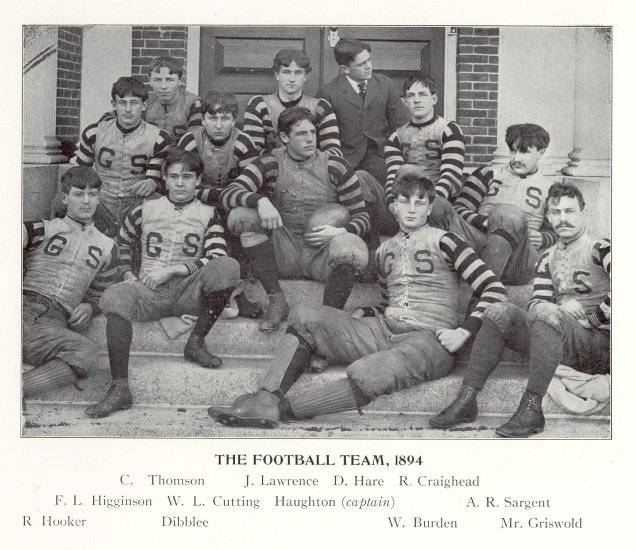
Sports Teams at Groton School, c. 1894-6

I came across these on eBay a couple of years ago, and snapped them up for literally a few dollars. I bought them because they show my great-grandfather, James Lawrence (1878-1969) and his friends and classmates at Groton, as they appeared in their youth.

Looking at them, I can’t help but be reminded of the wonderful scene in Dead Poets Society in which the main character, John Keating, played by Robin Williams, offers to his students the following timeless advice:

They’re not that different from you, are they? Same haircuts. Full of hormones, just like you. Invincible, just like you feel. The world is their oyster. They believe they’re destined for great things, just like many of you. Their eyes are full of hope, just like you. Did they wait until it was too late to make from their lives even one iota of what they were capable? Because you see, gentlemen, these boys are now fertilizing daffodils. But if you listen real close, you can hear them whisper their legacy to you. Go on, lean in. Listen. You hear it?… Carpe… Hear it?… Carpe. Carpe diem. Seize the day, boys. Make your lives extraordinary.

___________

Groton School yearbook photos 1894-1896 00004

Groton School football team, 1894

Thomson, Lawrence, Hare, Craighead, Higginson, Cutting, Haughton, Sargent, Hooker, Diblee, Burden, Griswold

Continue reading →

James Lawrence ‘01, “Mr. Grand”

These are just some notes I’ve put together—perhaps someday they will be an essay. But in the meantime, he is owed a place here…

_____________

No man can be summed up in a few lines. With that in mind, a few biographical facts, and some random recollections of friends follow.

President of his class at Harvard for four years, Harvard varsity football in 1899 and 1900, varsity crew 1899 and 1901.

Upon leaving college, he entered the office of George Mixter, banker and note broker, at 28 State Street, Boston.”–R. M. Lawrence, The Descendants of Major Samuel Lawrence.

Became a cotton merchant, first with George H. McFadden, then as a Boston partner of McFadden-Sands, and from 1931 on, senior partner of James Lawrence and Co.–Obituary, unknown newspaper, March, 1969.

Chief Marshall of his 25th Reunion at Harvard.

Active as director and trustee of many charitable, civic, and business enterprises, including Groton School, the Boston Safe Deposit & Trust Co., and the Boston Lying-In Hospital.–Obituary, unknown newspaper, March, 1969.

Called “Mr. Grand” by one of his grandchildren and the name stuck.

(Note, the Roman numeral designations for all subsequent James Lawrences stem from him, and are based on the number of James Lawrences alive in 1970-1971. My brother James, born in ’70, who goes by “IV”, is actually the sixth overall. His son, James, who goes by “Jack,” is the seventh.)

Mr. Grand was tough. In his youth, he used to sleep in the unheated Groton rooms, through the winter, with only a sheet over him. He later said that if you didn’t move a muscle, the air over your body would form almost a protective, insulating layer between your body and the cold. Frequently, he would leave the window open, while water in a drinking glass froze, and snow blew in. This is not a tall tale. Many have corroborated it.

After his death, his son, James Lawrence, Jr. (1907-1995), my grandfather, wrote a brief memorial for him, and had it printed with a red cover. It is a loving tribute. If you find it, sit down for a good read on this fabulous man.  A sample follows:


110

“James Lawrence” by Maria Di Carpenetto Lawrence


[Referring to the bust above]…the sculpture does not reveal that he was in all other respects, as well, the handsomest of men. Six feet three inches in his prime (he used to mutter with a twinkle in his eye that somewhere along the way he had lost an inch or two) he never ceased to hold himself like a young oak. Sitting in the library at Lower Faulkner with him night after night, I would steal a glance towards him occasionally to note  admiringly how straight he sat. Kipling could well have had him in mind when he spoke of [a] man’s being ‘like a lance at rest.’ Father was… always… not just some of the time.

–James Lawrence, Jr.


Continue reading →

Groton, MA c. 1888: The Caroline Estelle Mudge Lawrence Photo Album

Somewhere around 1887 or so, possibly earlier, Caroline Estelle Mudge Lawrence familiarized herself with the then-still-arcane process of photography and, to my reckoning, did something which for the time was quite unusual: she took pictures. Of her land. Her neighbors’ land. Animals she and others owned. Her husband, her children, her friends. Domestic life, well before the turn of the last century. It was, in a phrase, a thoroughly modern thing to do, and it was way, way ahead of its time.

Here, for the sake of preservation, and for the fun of seeing the daily reality of a family approximately 130 years ago, is the album…

(A brief editorial note: these are going up un-captioned. I’ll try to get names, places, etc. attached ASAP.–LSL)

__________

The Lost Sargents: ‘Recovering’ the Destroyed Portraits of Mr. And Mrs. James Lawrence

In 1881, the American artist John Singer Sargent painted dual portraits of husband and wife, James and Caroline Estelle Mudge Lawrence.

Much to many people’s everlasting grief, however, in 1939, both paintings were destroyed in a fire in Aunt Libby’s [Elizabeth Prescott Lawrence Emmons’] apartment.

For most of my life, it was my understanding that any substantive idea of what those paintings might have looked like had been lost, along with the originals, in the flames.

Over the last year, though, I have found two photographic reproductions of Estelle’s portrait, and one of James’  portrait. After some truly sparing and minimalist work in Photoshop, I offer them both below.

The best image of Estelle’s portrait came from a .pdf of an old Metropolitan Museum of Art catalog which had featured the painting: Memorial Exhibition of the Work of John Singer Sargent (January 4 through February 14, 1926). You can see a copy of it here; scroll to Plate 6.

The background, by the way, was described by contemporary viewers as being a brilliant red. Looking at the monotone image below, I can almost see the cadmium in my mind’s eye.


plate_6-post-2

John Singer Sargent
Mrs James Lawrence
1881
61 x 45.7 cm
Oil on canvas
Signed and dated upper right: John S. Sargent 1881
Destroyed by fire at Hingham, Massachusetts, Nov 21, 1938


The image of James’ portrait came from a photograph taken by Estelle herself. It was easily discernible on the far wall in an interior shot of the Lawrence Homestead at Groton.


james-lawrence-by-john-singer-sargent-destroyed-in-aunt-lizzies-apt-fire-1-9-in-w

John Singer Sargent
Mr James Lawrence
Exact dimensions unknown
c. 1881
Oil on canvas
Destroyed by fire at Hingham, Massachusetts, Nov 21, 1938


(Post Script: the newspaper article on the fire that destroyed the paintings can be accessed here, and here.–LSL)