Consoling Words From One of Mudge’s Comrades

As the Civil War raged, in the aftermath of Mudge’s death, Adjutant John Fox subordinated his own grief over the death of his brother to ease that of the Mudge family. To the colonel’s father he wrote,


I esteemed it a great privilege to be the first friend to receive his remains, and, with Colonel Morse, to perform those last offices which none but a friendly hand should undertake. Of his gallantry I need not speak,–it will be a house-hold word of every survivor of the regiment. My brother and Charley were classmates, and I hold it the sacred duty of my life to fight for the flag they died for, and to see that the cause for which they suffered is in the end triumphant over all its enemies. I hope that God may comfort and bless you and yours , even as I pray He may comfort my poor father and mother, and all who were friends of the loved and lost.


–The 2nd Massachusetts Infantry
at Gettysburg (1-3 July, 1863):
Vignettes of the Battle

http://www.geocities.com/pentagon/2126/gettyvig.html


Charles Redington Mudge’s Death and the Fog of War

In his excellent study, Gettysburg, Day Three, 2001, pp. 70-74, military historian Jeffrey D. Wert details the command decisions on the day Mudge was killed, and the probable miscommunication and/or misunderstanding that led to the order to “take the hill”…an order Mudge followed though he knew it almost certainly meant his death.

It is gripping reading, which I strongly recommend, and a wrenching anecdote of what has come to be called the fog of war.

Sadly, copyright restrictions prevent me from reproducing it here, or I would share it in full.

I tried to look for a short passage or two to quote under allowances for fair use, but you really have to follow the whole argument from beginning to end to appreciate the futility and the tragedy of what transpired.

You can buy the book here.

A Recent Article on Col. Mudge

A worthy piece of research bearing on Col. Mudge and the events at Gettysburg – written in the modern era – is the article, A CALL OF LEADERSHIP; Lt. COL. CHARLES REDINGTON MUDGE, U.S.V. AND THE SECOND MASSACHUSETTS INFANTRY AT GETTYSBURG, by Anthony J. Milano. It appeared in Gettysburg Magazine, January 1, 1992, Issue No. 6.

As usual, I would like nothing better than to reproduce it here, as it makes for fascinating reading. As usual, copyright restrictions prevent that.

I will offer though, from the article, a few excerpted lines from Mudge’s letters home.

They are just snatches, pieces, of an extended conversation between a son and his father. But I enjoy hearing the words in my mind, as he might have whispered them under his breath, writing in camp at night after a long day’s marching.

________

After Antietam:

…Our regiment went in, that is, was actually engaged three times in the battle of Wednesday. Twice we were very fortunate, making the rebels run and not suffering ourselves, but the other time we got the worst of it, losing fifteen killed and fifty-five wounded out of less than two hundred….I got a blow on the ribs from a ball which penetrated through my blouse, vest, and two shirts, and skinned my ribs, but only disabled me for a few moments. I thought I was killed when it struck me, but recovered almost immediately…there are no words left to express what Wednesday’s fight was,—the whole ground was fought over twice, each side feeling how great an issue was at stake.


–C.R. Mudge to E.R Mudge, Maryland Heights, September 25, 1862

Comey Family Civil War Papers, Box 1, Folder 13, Manuscript Collection of the American Antiquarian Society.

After Chancellorsville:

…Our men behaved better than ever. Cogswell was wounded early, and then I took command,—gaining and holding ground for fifteen minutes without a cartridge,—until ordered to retire, which I did very slowly, halting and facing frequently. We took in four hundred and thirty men and twenty­ two officers, and lost, as near as I can get it at present, twenty‑two men killed, ninety‑eight wounded, sixteen missing,—one officer killed, four wounded, several grazed. I think the killed is larger, as some of the wounded could not have lived long….The colors are getting to look a little hard….3


–C.R. Mudge to ER. Mudge, Extreme left of the Army of the Potomac covering the United States Ford, May 5, 1863

Comey Family Civil War Papers, Box 1, Folder 13, Manuscript Collection of the American Antiquarian Society.

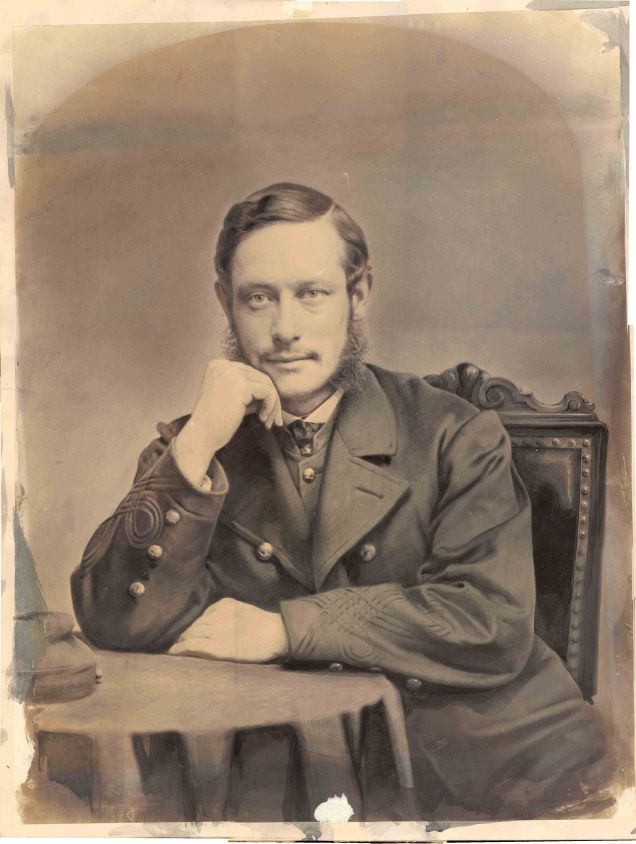
Charles Redington Mudge, As Photographed By John Adams Whipple

At some point in the course of the war, Charles Redington Mudge sat for the well-known photographer, John Adams Whipple.

During that time, Whipple made several plates. At least three that I know of. One of Mudge standing, and two sitting.

In the preceding post, I showed the standing pose. But by far the most common, and emotionally resonant, are the two that show  Mudge seated– one with his hand under his chin, the other with his hands folded on the table.

There are many versions of the “hand under chin” frame. Most of them are cropped and low resolution. Good at best, not great.

In the early 2000s, I took a period print of this frame, currently in a family residence, to be archivally re-matted, and I used the opportunity to make a high resolution scan of it. This particular print is quite large and may actually have been part of the studio’s retouch process. A grayish wash or ink has been directly applied to the paper, smoothing out both Mudge’s uniform, and the drapery over the table.

Here below, is a version of that scan, sized for the Web.


mudge-complete-portrait-low-res


Continue reading

Charles Redington Mudge in Harvard Memorial Biographies

The following was originally published in Harvard Memorial Biographies, and later reproduced in the book Mudge Memorials, by Alfred MudgeAlfred Mudge, Boston 1868, pp. 370-382. I have included it here in its entirety, preserving the original spellings.
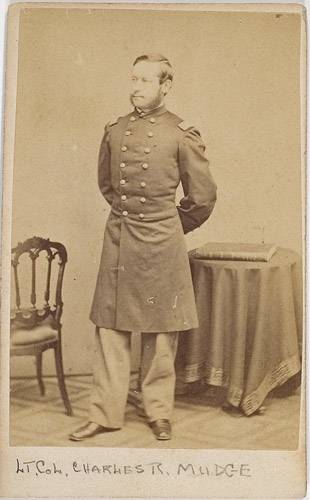
 

cdv-of-lt-colonel-charles-e-mudge-2nd-mass-kia

CRM, photo [CDV or carte de visite] taken by John Adams Whipple (Boston, MA).


________________________


Charles Redington Mudge

First Lieutenant 2d Mass. Vols. [Infantry], May 25, 1861; Captain, July 8, 1861; Major, November 9, 1862; Lieutenant-Colonel, June 6, 1863; killed at Gettysburg, Pa., July 3, 1863.

Charles Redington Mudge was the son of Enoch Redington and Caroline A. (Patten) Mudge. He was born in New York City, on the 22d day of October, 1839. He studied for several years at the private school of Mr. Thomas G. Bradford, at that time a favorite teacher in Boston; and went thence to Harvard College in the summer of 1856, joining the Class of 1860. The most salient point in his college career was, beyond question, his exceeding popularity,—a popularity of an unusual and very flattering nature, which made him an especial favorite in his own chosen circle, and also left him perhaps nearly the only man in the Class who could be sure of a kind word and friendly deed from every member. In his case, this popularity was founded upon a remarkable unwavering kindliness of nature. An instinct assured each classmate that there could be no chance of a word of harshness or of sarcasm from him. It was his nature to appreciate the good traits of every one. Each comrade felt that Mudge saw the bright side of his character, and recognized all his best qualities. He had many accomplishments, too, of a nature highly esteemed by young and old. He had a good voice and ear, and sung with spirit from an inexhaustible repertory. He was lithe, muscular, and athletic in build, and very. fond of manly sports and exercises. He was a good oarsman, an excellent boxer, and distinguished in the Gymnasium. During nearly the whole of his college course he belonged to a club‑table, very many of the members of which have since won for themselves honorable names in the war, of whom Colonels Rob’t G. Shaw, Caspar Crowninshield and Henry S. Russell may be mentioned as perhaps the most conspicuous. He was an active and prominent member of the Glee Club, and a leading “brother” of the Hasty Pudding Club. Of the last he was also, during one term, Vice‑President.

After graduating he made preparations for entering the manufacturing business, in which his father’s prominent position gave him promise of an excellent opening. But the breaking out of the war at once changed his occupation, his objects, and his destiny. Every dweller in Boston and vicinity must have a fresh personal recollection of the prompt emulation with which young men from Boston and its neighborhood hastened to solicit commissions in the Second Regiment of Massachusetts Volunteers; and among these Mudge was enrolled from the outset, his commission as First Lieutenant bearing date May 26,1861. He wrote, Nov. 16,1862, looking back to these opening scenes:—

If you will just look back to that Sunday morning when you and I jumped out of our beds at the news of the capture of Fort Sumter,—I fully made up my mind to fight; and when I say fight, I mean win or die. I do not wish to stop the thing half‑way. I wish to establish the government upon a foundation of rock.

The results of this earnest trust and stern intent were marked and admirable in him, as in so many others. Boyish things were put off, and their place was filled by a thoughtfulness, a depth of moral conviction, and a steadiness of moral purpose, not often to be found in a young man scarce twenty‑two years of age.

Continue reading

Charles Redington Mudge

Lt. Col. Charles Redington Mudge, or Charley Mudge as he was known to friends and family, was Mr. Grand’s [James Lawrence 1878-1969] uncle, the brother of his mother, Caroline Estelle Mudge Lawrence. Mudge fought in the Civil War, in numerous key battles, and by the time of his death at twenty-three, he had risen to the rank of lieutenant colonel. He was killed at Gettysburg, on the third day of fighting when – leading a charge that could be called the very definition of bravery – a ball struck him just below the throat.

In the year of his death, the following obituary appeared in a Harvard alumni publication.

____________________


Association of the Alumni of Harvard College

 Necrology of the Past Year

col-mudge

1863. Lieutenant‑Colonel Charles Redington Mudge was killed in the battle of Gettysburg 3d July, 1863, aged twenty-three years. He was the son of Enoch Redington and Caroline A. [Patten] Mudge, and was born in New York City 22d October, 1839. He was fitted for college at the private school of Thomas Gamaliel Bradford H.U. 1822] in Boston. With the exception of a few months passed in preparing to enter business with his father, he was in the service of his country—having joined the 2d Mass. Infantry—the first three years’ regiment raised for the war. He went into the service with his whole soul. He was commissioned as First Lieutenant, was promoted to be Captain July 8, 1861, and was subsequently made Lieutenant‑Colonel. While encamped at Brook Farm he slept on the bare ground to prepare himself for the life which he was to lead. His regiment was spoken of as a model for its admirable drill. When they covered the rear of General Banks’ retreat, Colonel Mudge was with them in their dangerous path; and in the battle of Winchester, May 25, 1862, received his first wound. The officers of his regiment never failed to express their opinion of his military qualities and abilities in the highest terms. But there are other traits in his character which will be remembered with the warmest affection by his young contemporaries. In his college course his popularity was universal, and he was a favorite in every clique, and in the most different sets. Every one was his friend in need, and no one would have hesitated a moment to have asked his services with the certainty of a kind reception.

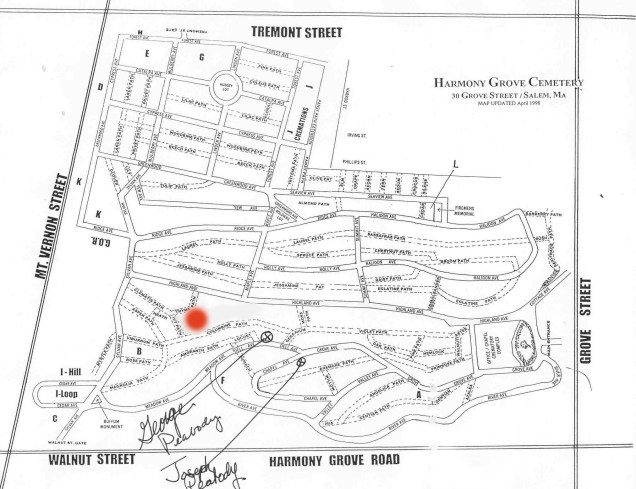
Harmony Grove Cemetery, Salem, MA

Directions to Harmony Grove in Salem, MA, tel: (978) 744-0554:

From 128 N take the exit opposite the North Shore Mall (#25), marked 114 E towards Salem. Drive along the twists and turns of 114 until, coming into Salem, you hit a large traffic light. Go R onto School St. and follow that up a hill until it T’s out, and then go L, maybe twenty yards until you come to the stop sign. Go R and you’ll start down a hill, with the road curving to the left. The entrance to the cemetery is about 200 yards past the stop sign on the right.


Once you’re there…

Proceed into the grounds, past the chapel on your left, and drive along the hillside on Highland Ave. After passing two paved cemetery roads on your right, Summit Ave. and Maple Ave., you’ll see a little path running down the hill on your left. This is Thyme Path. Park and walk down. Officially, the Peabodys are on Ivy Path, but it doesn’t matter. You’ll see the assembled family on your left. They include:

  • Endicott Peabody d. 10/30/1909
  • George L. Peabody d. 2/10/1911
  • Marianne Cabot Lee Peabody d. 10/11/11
  • John Endicott Peabody d. 8/17/1921
  • Gertrude Lawrence Peabody d. 5/2/1883
  • Martha Whitney Peabody d. 6/17/1934
  • Rosamund Lawrence Peabody d. 6/8/1935
  • Francis Peabody d. 2/9/1938
  • Montague W.W. Prowse d. 11/24/1954
  • Samuel Endicott Peabody d. 10/14/1959
  • Harold Peabody d. 9/6/1961
  • Marian Lawrence Peabody d. 4/23/1974
  • Martha Peabody Prowse d. 8/29/1975


As a miscellaneous note, Gertrude was originally buried in lot # 1158, Francis Peabody’s lot, but was later moved to #1553. This would speak to her death preceding those of her neighbors by at least 25 yrs.

Also, George Peabody’s immense memorial is also there in Harmony Grove, and you can see it as you drive along Highland Ave., down the hill, on your left. It is just past the point where Meadow Ave turns into Dell Ave, at the entrance to Locust Path. Capt Joseph Peabody is nearby, where Dell Ave. meets Chapel Ave. and Grove Ave.


Harmony Grove Salem MA grounds

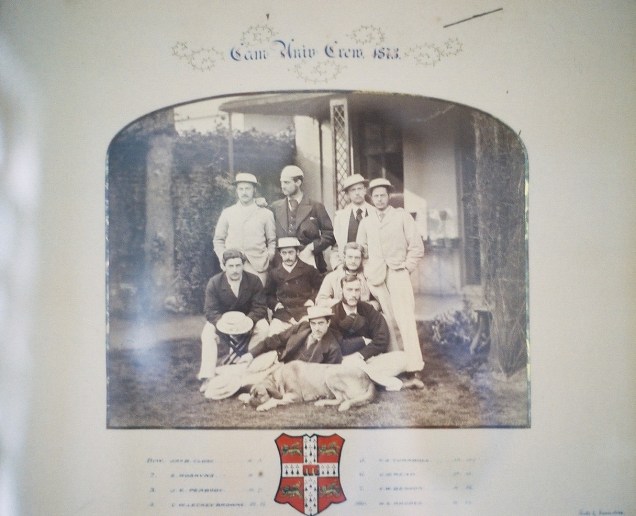
J.E. Peabody and the Cambridge Crew of 1873

At some point in his education, J.E. Peabody spent a year in England at Cambridge University, and, as an elite oarsman in his own right, was allowed to row on their crew.

We still have the team photograph, which several years ago I made the executive decision to disassemble and copy.

For a long time, I had no idea which of these men was our ancestor– I had only seen pictures of Peabody in his elder years, which wasn’t much use.  Then I happened across another photo from his college days, this one helpfully labelled by my Great-Uncle John. And now we know: Peabody is in the back row, second from right.

________

Before coming out from the glass… Pretty rough.

13340179_199903027071207_6521932219713255368_o


Out of the glass… Better.

13411775_199904097071100_7302312371198353160_o

Continue reading

Gertrude (Lawrence) Peabody

Gertrude Peabody’s memory was virtually erased from our family’s oral history, for reasons that can be only guessed at, and restoring a sense of who she was has been difficult. The scraps that follow represent all the fragments I have been able to assemble. Perhaps someone will turn up a collection of her letters, or some other trove, and someday we will have a chance to know her a bit better…

____

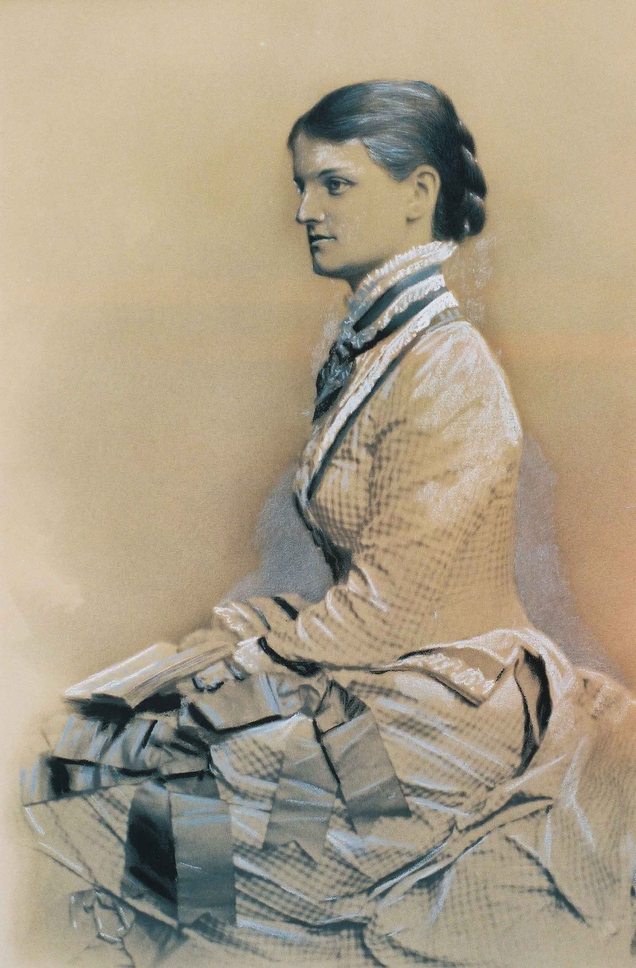
There is a wonderful sepia photograph, retouched with pastel, of Gertrude Lawrence Peabody in the dining room at Dark Harbor. It belongs to Lee Albright. It shows the same strong face and jaw so admired in Grandfather [James Lawrence 1907-1995—LSL].

Gertrude Lawrence Peabody for WORD file

Lee told me, in August, 2001, that she had often looked at the portrait and wondered how Gertrude had died, since she was only 28. She said that Grandfather had often wondered the same thing. This piqued my interest, and I then began the process of looking into not only how this woman died, but who she was while she was alive.

Continue reading

The William Hickling Prescott House

William Hickling and Susannah (Amory) Prescott’s house survives, and is owned by The Colonial Dames of America in The Commonwealth of Massachusetts, and can be visited.

141

from the Colonial Dames’ website:

Location:

55 Beacon Street ~ Boston, MA 02108

Telephone:

617-742-3190

2016 Open Dates:

Saturdays in April;
Wednesdays and Saturdays in May, June, July, August and September;
Saturdays in October

Tours run from 12-4 p.m.


Continue reading