The Farrar Homestead, Lincoln, MA


There are only a few extant photographs of the house in which generations of Farrars were born, raised, lived, and died– and from which, lest we forget, Mercy Hoar Farrar fled the British.

(Note the span of time between these images, visible in the change in height of the white pines out back.)

Farrar Homestead from Beneath Od Roof Trees

The Farrar Homestead, from Beneath Old Roof Trees, Chapter 18.

Farrar-Homestead-large

The Farrar Homestead, from the Lincoln town archives


There is also this worthwhile account of the house’s history, written c. 1847:

______

from Beneath Old Roof Trees, Chapter 18, pp. 215-8

Online version available here and here.

Continue reading

Fear Among the Citizens of Lincoln Following the Battles of Lexington and Concord

There’s a short but interesting primary account that touches on the profound fear among the citizens of Boston’s surrounding towns, following the Battle of Lexington and Concord.

After the fighting, the British were making their retreat along the long road back to the city.

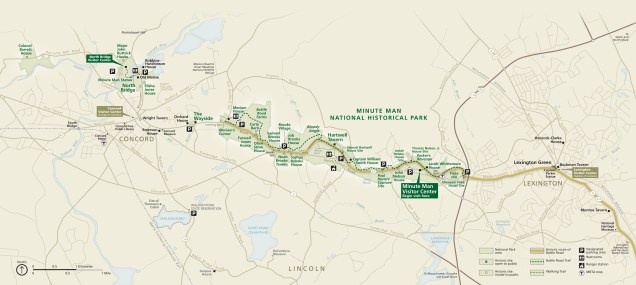
MIMA Park Map 2014

Mercy Hoar Farrar, wife of (then) Lt. Samuel Farrar, Jr. and my 4th great-grandmother, was making no assumptions about the behavior of the troops.

As one of the Farrar grandsons would later tell it…

The Concord families living nearest to our home fled this way for safety, and with my grandmother and others of the family left this house, [they] took refuge in “Oaky Bottom,” a retired piece of forest land about one-half mile in the rear of the house. Grandmother in her haste had sufficient self-possession to think of the cattle tied in the barn. These she let loose, desiring to save them from the flames that she expected would be kindled by Gage’s army. She took her babe, Samuel (the third), in her arms, the large family Bible, a loaf of bread, and a looking-glass, with what little silver she had, and bade farewell to the old dwelling, never expecting to gather her family about her again beneath that ancestral roof.

–quote taken from MacLean, John C., A Rich Harvest, Lincoln, MA, Lincoln Historical Society, 1987. p. 276

At the end of that momentous day, happily, the house was intact.

To find out more, click over to the Farrar Pond website, and read Kathy Garner’s excellent post on these events.

I’ll focus on the long and rich history of the Farrar Homestead in the next installment.


Captain Samuel Farrar, ‘The Son’

This entry is really a placeholder.

Briefly, as I mentioned in my last post, Deacon, and also Lieut., Samuel Farrar, Sr. (1708-1783) had a son, Lieut., and later Capt., and subsequently Deacon, Samuel Farrar, Jr. (1737-1829).

Father and son were both committed participants in the cause of independence: the father, primarily as a citizen-activist in the lead-up to the war and participant at the Battle of Lexington and Concord; the son as a soldier throughout the length of the war, which included command of a company of Massachusetts volunteers.

After April 19, 1775, (then) Lt. Samuel Farrar, Jr. went on to participate in the Battle of Bunker Hill, and helped to fortify Dorchester Heights. As I noted above, he was later promoted to Captain, and, after two more years of fighting, was present at Saratoga when Burgoyne surrendered.

For whatever reasons, when the 19th century histories were written about the Revolution, the father received a good deal more ink than the son. While I suspect the son’s contributions were no less significant, I have found nothing more on him. Clearly, more research needs to be done on this man.

Consider that a thinly veiled plea, by the way… If anyone reading this has any leads or pointers, please do pass them along !

(To be continued…)

Deacon Samuel Farrar, ‘The Father’

Deacon Samuel Farrar was a senior and respected member of the Lincoln community, and I suppose you could say, he was one of the local organizers of the first stages of the colonial resistance. He also fought in its first battle, at the tender age of 66.

There isn’t a huge amount written about him, and some of what I have found is copyrighted, but I can pass along this.

[A quick note to say that he also had a son, whose name was Samuel, who fought in the Revolution, and who eventually became a Deacon creating ample room for confusion about who did what. Consequently, I’ve used the term ‘The Father’ in the title of this post, and I’ll use “The Son” in the one to follow. Elsewhere, I’ve gone with the suffixes Sr. and Jr. though the men themselves did not. Lastly, the writers from the mid-1800s typically refer to the older man as Deacon Samuel Farrar, and the younger man as Captain Samuel Farrar. FWIW. –LSL]

_______


from Memoir of the Farrar Family, by Farrar, Timothy, 1788-1874. Publ. 1853 [Lightly edited for clarity.–LSL]


FARRAR FAMILY

Samuel Farrar, 4 the fourth and youngest son of George, 3 born Sept. 28, 1708, settled on the central or homestead portion of his father’s farm, married Jan. 13, 1731-2, Lydia Barrett, daughter of Capt. Benjamin Barrett, born Aug. 2, 1712. He was deacon of the church ae. 75, she died June 1802, ae. 89. Children: 1. Lydia, born Sept. 2, 1735, married William Bond, March 6, 1755; 2. Samuel, 5 born Feb. 14, 1737, married Mercy Hoar ; 3. Stephen, 5 born Sept. 8, 1738,______, graduated Harvard 1755 ; 4. James, born July 24, 1741, died at New Ipswich, July 11, 1767; 5. Rebecca, born Aug. 13, 1743, married Dr. John Preston, Nov. 29, 1764 — [see Hist. New Ipswich, and post, pp. 18, 19 :] — 6. Lucy,5 born April 27, 1745, married Humphrey Farrar, 5 ; 7. Timothy,5 born June 28, 1747, graduated Harvard 1767; 8. Mary, born July 5, 1754, died Sept. 2, 1756. For some particulars of the life and character of Dea. Samuel,* see Shattuck’s Hist. of Concord, and Hist, of New Ipswich, p. 358; also post, pp. 15. 16…

…Conspicuous among the early, though not among the first settlers of New Ipswich, were four members of this family.

…Dea. Samuel Farrar 4…was born Sept. 28, 1708, the youngest son of George 3 , who first settled in that place in 1692, and great-grand-son of Jacob 1 , who was one of the original proprietors of Lancaster, Mass., in 1653.

…he lived and died on his father’s farm in Lincoln, where his descendants still live…

…He married, Jan. 13, 1731-2, Lydia. daughter of Capt. Benjamin Barrett, and grand-daughter of James Minot, Esq., ” who was one of the most distinguished men of his day in Concord.” She was born Aug. 2, 1712, and died in June, 1802, in her 90th year. He was much interested in public affairs, frequently serving his town as Selectman, Town Clerk, Representative, &c., and was a patriot of great zeal, steadiness and perseverance. He was Selectman of Concord in 1754, when Lincoln was set off, and afterwards for many years Town Clerk and Representative of the new town.

In Nov. 1773, he was Chairman of the first Committee of Correspondence, and afterwards a member of the great Middlesex Convention of Aug. 30, 1774, which led off in the Revolution, by Resolving, among other things of similar import,

“That it is our opinion these late acts [of the British Parliament.] if quietly submitted to, will annihilate the last vestige of liberty in this Province, and therefore we must be justified, by God and the world, in never submitting to them.

He was also a member of the first Provincial Congress, which met Oct. 11, 1774, and at the age of 66 years, took part in the first battle of the Revolution, at Concord, Apr. 19, 1775.

He died soon after the conclusion of the war, Apr. 17, 1783, in the 75th year of his age, having witnessed the establishment of the independence of his country, and endured the hardships of its acquisition, but leaving to his posterity the enjoyment of the rich inheritance of its blessings.


Assorted Sermons and Discourses of Rev. Jonathan French, Sr.

Jonathan French Sr.’s sermons have survived, but they are somewhat hard to find. Here, in the form of some admittedly poor reproductions, are six.


[The titles below are clickable hyperlinks, and will take you to PDFs of the actual texts.–LSL]

____________


THE PUBLISHED WORKS OF  JONATHAN FRENCH, SR. (1740-1809, Father)

  1. A practical discourse against extortion, from Ezekiel XXII, 12. Delivered at a lecture in the South Parish in Andover, January 1, 1777. Published at the desire of the hearers.
  2. A sermon preached before His Excellency Samuel Adams, Esq. governour; His Honor Moses Gill, lieutenant-governour; the Honourable the Council, Senate, … Commonwealth of Massachusetts, May 25, 1796.
  3. A sermon delivered on the anniversary thanksgiving November 29, 1798: with some additions in the historical part.
  4. A sermon, preached at the ordination of the Reverend James Kendall, over the First Church and Congregation in Plymouth, January 1, 1800.
  5. A sermon preached at the ordination of the Rev. Jonathan French, Jun.: over the church and congregation in Northampton, in Newhampshire [sic], November 18, 1801.
  6. A discourse delivered at an evening lecture, in the South Meetinghouse, in Portsmouth, N.H. 21 July, 1805: it being the evening succeeding the session … of the Reverend Timothy Alden, Junior.


APPENDICES

  1. A sermon, preached September 23, 1772, at the ordination of the Reverend Jonathan French, to the pastoral charge of the Second Church of Christ in … Pastor of the Second Church in Braintree. by Weld, Ezra [Not a sermon by French, but rather the sermon preached by Ezra Weld at French’s ordination. Included because, well, just because… –LSL]
  2. A Collection of American Epitaphs and Inscriptions, Vol. 2: With Occasional Notes; Pentade I.  by Alden, Timothy  [Also not a sermon by French, but this is THE Alden bio of French, the one I used for the previous post, just in a different volume.–LSL]


The Life of Jonathan French (1740-1809), As Told By Timothy Alden

As the preceding post might suggest, French was a fascinating man. But he lived at a time when few New Englanders wrote memoirs, or were celebrated in an individual way. We are lucky that the Rev. Timothy Alden felt French’s life was sufficiently important to merit any biography at all, however brief.

I won’t say this text was almost lost to history, but that wouldn’t be much of an exaggeration. It took me three weeks of looking to locate it.

The first version of Alden’s text is cited below; it is the original, which is next to impossible to find outside of an academic library:

Memoirs of the late Rev. Jonathan French, A.M. of Andover, in Massachusetts, who departed this life suddenly, 28th July, 1809.–Æt. 70.

by Timothy Alden, publ. 1810

A WorldCat library citation is available here.

The second version is actually from an anthology of sorts of Alden’s writings, but is more readily available:

A collection of American epitaphs and inscriptions, with occasional notes 

by Timothy Alden, publ. 1814

This can be read here.

I’ll lead off with an OCR/ digital version of the text. So that search engines can find it, and young students doing research for a school paper, etc., can have something to copy and paste from.

I have also included, though, at the end, the images of the original document.

As I said, this man deserves to be remembered, and I want to do as much as I can to help that happen.


Continue reading

Jonathan French: Soldier, Surgeon, Minister

If I had to pick a single ancestor whose life trajectory I most admire, it would have to be this man. As a youth, he volunteered for and fought in the French and Indian War. In his young adulthood, he was a respected surgeon. And from the middle of his life to the end, he was a beloved minister. That, to me, is the trifecta of use to one’s community; offering at each distinct stage of his passage through this world what he best had to give.

If these next few posts can encourage in others a fraction of the respect I feel for him, and help to keep his name and his example alive, I’ll view this site as having been worth the time.


______

Historical Sketches of Andover (comprising the present towns of North Andover and Andover), by Bailey, Sarah Loring, 1880

https://archive.org/details/historicalsketch00bail

Rev. Jonathan French, 1740-1809

pp. 279

A relic of the military service of Rev. Jonathan French, in this war, has been found among his papers, in possession of his descendants at Andover, — an Almanac which has his name and “Castle William” written on it. It is for the year 1761. It contains the following verses on the victories of our arms, which, no doubt, thrilled the sensibilities of the then Sergeant French : —

“How shall my muse in proper lines express Our Northern Armies Valour and Success? While I am writing comes the joyful news Which cheers my heart anew inspires my muse. Our three brave armies at Montreal meet, A conquest of New France they three compleat. To God we owe the Triumphs of the Day ; New France submits to George’s gentle sway. May Lewis that proud tyrant never more. Bear any rule upon this northern shore !”

____________

pp.327-8

The day of the Battle of Bunker Hill and the night which followed, were full of terrible anxiety and suspense to the friends trembling for the fate of their kindred and townsfolk. From the high hills they strained their eyes to catch a glimpse of coming messengers, and watched the lurid fires of the burning city stream up on the horizon, while the incessant booming of the cannon made even stout hearts quail and all tremble for the fate of friends on the battle-field.

The next day was the Sabbath; but who could sit down in the meeting-house and listen to sermons, or compose his mind for the duty of public prayer, however devout he might be! Concerning the state of things, the pastor of the South Church, the Rev. Jonathan French, writes: —

“Our houses of public worship were generally shut up. It was the case here. When the news of the battle reached us, the anxiety and distress of wives and children, of parents, of brothers, sisters, and friends was great. It was not known who were among the slain or living, the wounded or the well. It was thought justifiable for us who could to repair to the camp to know the circumstances, to join in the defence of the country and prevent the enemy from pushing the advantages they had gained, and to afford comfort and relief to our suffering brethren and friends.”

With surgical instruments, for he was a practical surgeon, and musket, for he was a trained soldier, and Bible, as became his profession, the Rev. Dr. French made his Sabbath day’s journey to the camp, and rendered valuable aid there in ministering to the wounded and the dying.

Continue reading

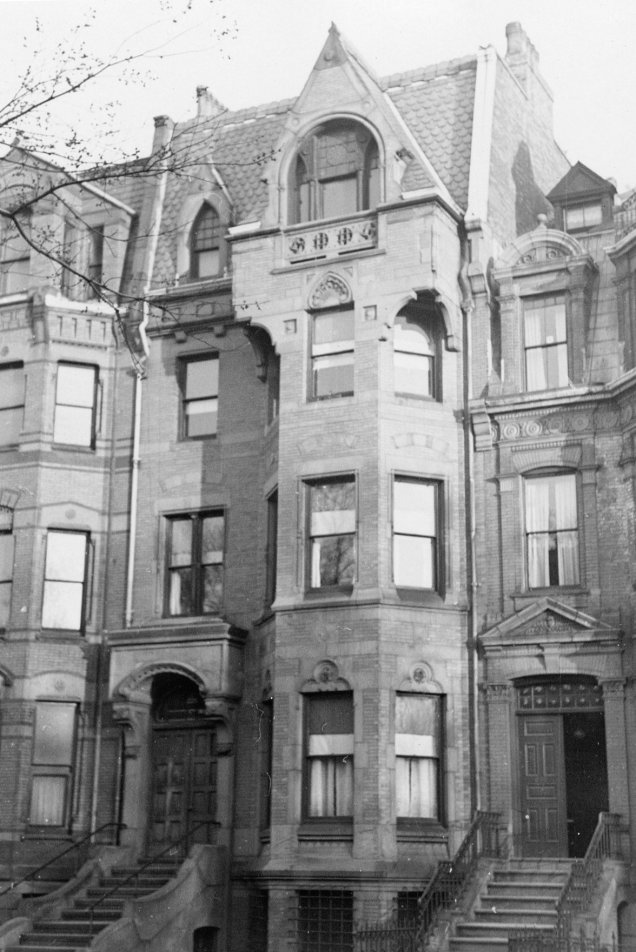
‘226 Commonwealth Ave.,’ Dr. Howard T. Swain’s office and home

I mentioned in a previous post that the physician and Harvard Medical School professor, Howard T. Swain, maintained – in the time-honored tradition of doctors everywhere prior to say, 1930 or 40 – a true home office.

The downstairs floor of the house at 226 Commonwealth Ave. in Boston’s Back Bay was the location for his large obstetrical, gynecological, and (I infer) pediatric practice. The upstairs floors were for his family, and, as such, held many of my grandmother’s – his daughter, Helen Swain Burgin’s – sweetest memories.

For several years after college, when my grandmother was “at home” (a 19th and early 20th century phrase connoting a sort of existential purgatory for talented but unmarried women), she would accompany her father on his home visits to see patients. Working as his assistant, she and the man she adored would go out from and return to this place each day.

In her elder years, probably the late ’80s,  I remember one car trip into Boston during which, at her request, we intentionally drove by the house and live parked in the street, flashers on and blocking traffic, while she looked up at it, one last time, saying nothing.


Howard Swain's office and home at 226 Commonwealth Ave

226 Comm. Ave. – Howard T. Swain, M.D.’s office and home


Howard Townsend Swain, M.D.

Howard Townsend Swain, M.D. was the much-loved and revered patriarch of my grandmother’s family.

hts-older-man

He was called “Buppie” by close kin. That’s at least the way I’ve chosen to spell his nickname.

(A note to younger readers who have never heard it pronounced: I don’t know if it was ever written out. At any rate, it is said with the “u” sounding like “oo” in look, or book. So think, Bookie, and then substitute a p for the k. Buppie. Or if you want to really be technical, /ˈbʊpi/, but I never learned to read “dictionary-speak,” and come to think of it, don’t know anyone who did. Continuing with this minutiae on the subject of names, he appears to have been named, actually named, for a Dr. Howard Townsend, Professor and Chair of Obstetrics at Albany Medical College where his father, William Dexter Swain, M.D., had studied medicine.  Dr. Townsend died in January, 1867, shortly before Howard Townsend Swain’s birth.)

As a young man, Buppie came from a relatively simple rural life, but he rose within the Boston medical establishment to become a widely respected and sought-after physician.

It was said – often – that although he was an ob/gyn, men would nevertheless make appointments with him just to seek his counsel, coming to see him in his home-office at 226 Commonwealth Ave.

My grandmother, Helen Swain Burgin, his daughter, mentioned him in passing at least once every couple of days when we were together, and I think she thought of him even more often. It would not be overkill to say his presence, the fact of having known him, was one of the great anchors or touchstones of her life.

After he died, an unknown Boston newspaper dated Thursday, Dec 10, 1936, took note of his passing with a small two paragraph notice entitled “Affection,” which reads as follows:

“Rarely has such a tribute been paid to a doctor as at the funeral of Dr. Howard T. Swain, the distinguished gynecologist yesterday. In the past 30 years he brought into the world the children of hundreds of Back Bay families. He was more than a physician, he was a devoted friend and counsellor of mothers and children. They came to rely on his advice in many things.

“It is a splendid thing for a man to have earned such wide affection. Those who gathered for the last tribute to him were those who had personal reasons to cherish his memory.”

hts-funeral-service
_____

Continue reading